

在暴君活着的时候就喊出反对:文革中的公民抗争
Speaking Out While the Tyrant Still Lives: A Valuable Archive of Civic Resistance During the Cultural Revolution

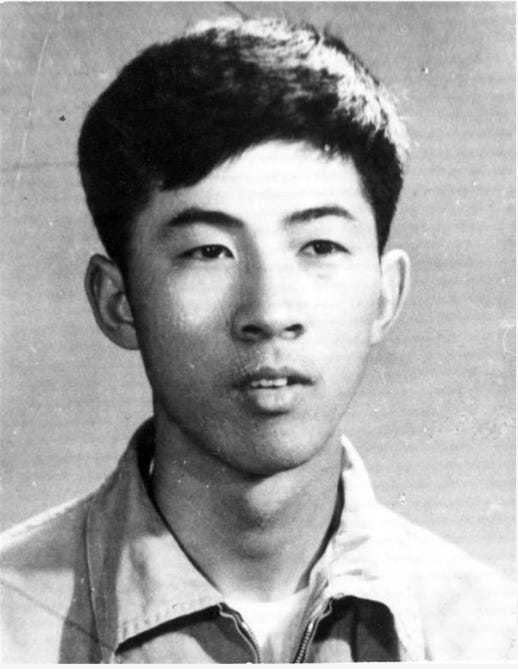
作者:胡平
By Hu Ping
The English translation follows below.
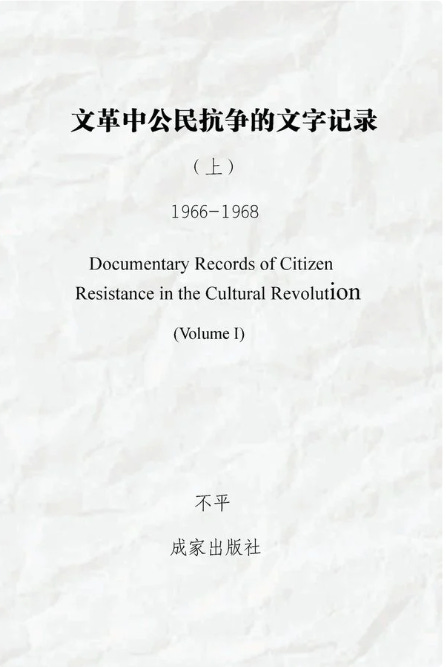
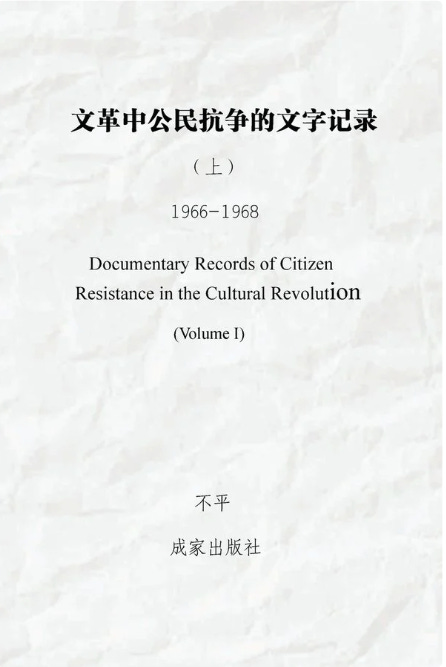
正值文革60周年之际,今年6月,美国成家出版社出版了《文革中公民抗争的文字记录》一书。这是一部以编年方式呈现的中国民间抗争史料集,收录的资料来源于地方志、判决书、报刊以及其他原始文字记录。书中,以时间为轴,将散落在各种载体里的中国民间抗争片段重新串联,呈现了文革时公民反抗的连续性及历史脉络。
1
《文革中公民抗争的文字记录》一书,分上、下两大册,共947页,由不平(本名许绍吉)编著。
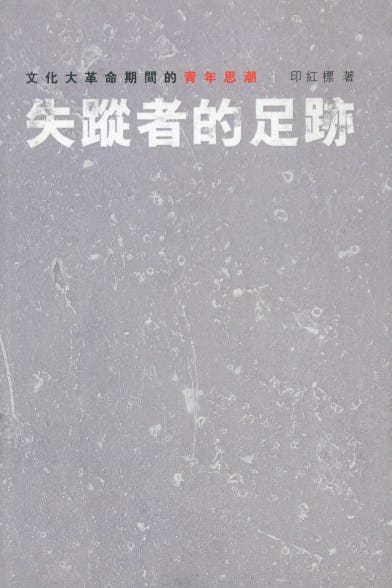
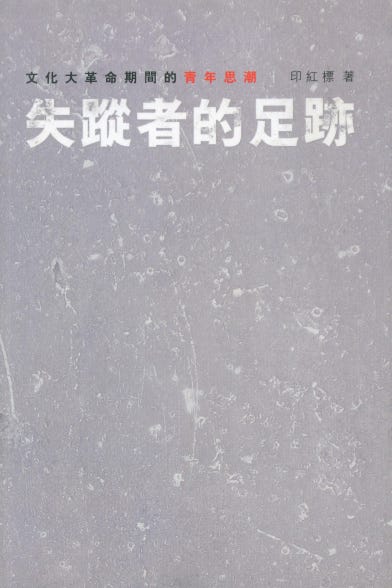
我与不平未曾谋面,但很早就读过他的书和文章,也看到过别人对他的介绍,例如印红标在《失踪者的足迹——文化大革命期间的青年思潮》一书中,就对他有长达8页的介绍。我们是同龄人,都是文革前的高三级学生(他当时就读于上海同济附中);都在文革中开始了独立的批判思考,呼吁思想自由和言论自由;也都在文革结束后考上了大学,读了研究生;又先后都来到了美国。不平长期以来致力于文革研究及文革史料的发掘,尤其注重文革期间的公民抗争——这也是我一直关切的。
“在历史的狂风巨浪中,寻找中国的良心与脊梁。”不平曾如此描述自己出版此书的初衷。
文革是一场席卷中国的浩劫。在个人崇拜狂热蔓延、普通百姓噤若寒蝉的腥风血雨年代,中国人民的思想与声音遭到了前所未有的钳制。然而,中国人并非全是盲目顺从的“无脑儿”与“软骨儿”。面对“公安六条”(即1967年1月颁布的《关于无产阶级文化大革命中加强公安工作的若干规定》),以及一系列残酷的倒行逆施与严刑峻法,一批有骨气,有血性,也有头脑的勇者挺身而出。即使声音微若蚊鸣,他们依然向狂暴的时代喊出了最坚定的“不”。其中一些人,不畏酷刑、无惧监狱,甚至付出了生命代价,留下了挑战暴政的历史身影。
有关文革期间民间异议者的史料,此前已经出过几本书。重要的有如下:
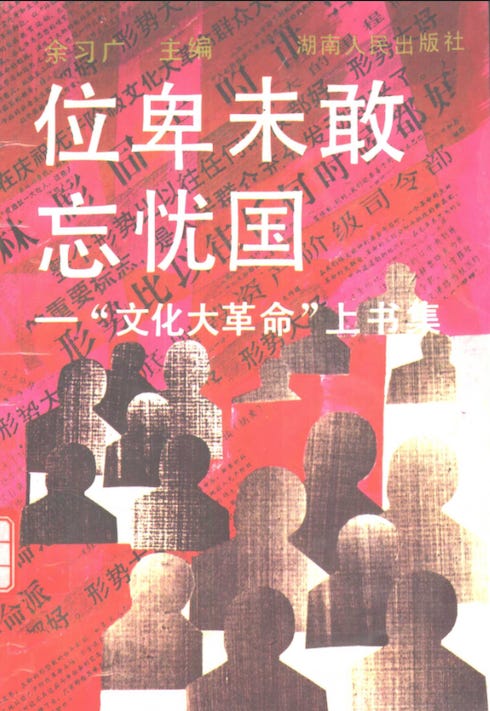
1、余习广《位卑未敢忘忧国:文化大革命上书集》(湖南人民出版社,1989)。这本书收集了文革期间普通人(多为普通干部、青年学生、知识分子或百姓)向上级、中央或毛泽东本人的上书、信件与进言材料,内容多为对文革错误政策、派性武斗、干部迫害等问题的批评与建议。
2、宋永毅与孙大进合编《文化大革命和它的异端思潮》(香港田园书屋,1996年)。这本书汇集了文革时期“异端思潮”的代表性文章,并附有分析,展现出文革中异端思潮的演进与发展。
3、印红标《失踪者的足迹:文化大革命期间的青年思潮》(香港中文大学出版社,2009年)。这本书是对文革时期民间思想史的挖掘与梳理,系统考察了文革时期中国青年社会政治思潮的演变,并指出这些思想者在当代中国思想史的特殊意义。
4、宋永毅《从毛泽东的拥护者到他的反对派——“文革”中异端思潮文献档案》(上、下册,香港国史出版社,2015年)。这本书选编了文革中93篇最重要的异端思潮文献,探讨红卫兵一代如何从狂热拥护毛泽东转变为反对派的思想过程。
5、宋永毅《文革中公民异议文献档案汇编》(上、下册,香港国史出版社,2018年)。这本书收录了近70名异议人士在文革期间挑战官方统治的个人文献,其形式有匿名传单、私人信件、日记、狱中手稿等。
另外,还必须提到的是王友琴《文革受难者——关于迫害、监禁和杀戮的寻访实录》(香港开放出版社,2004年)。作者通过长期采访与调查,详细记录了659名文革中被迫害致死的普通人的姓名与遭遇。以受难者的视角呈现文革的罪恶,来对抗官方叙事中对普通人苦难的忽视。
2
那么,和上面几本书相比,这本《文字记录》有何特点呢?
首先,这本书非常看重“说出来”。这本书收录的文字,不是亲友间的私下交流,也不是抽屉文学,而在当时就以各种方式被公开说了出来。作为文革的过来人,我和本书的编辑不平先生一样,能体会到这些文字的作者当时充溢心中的不可遏制的冲动:说出来,一定要说出来。要在暴政肆虐的时候就说出来,要在暴君活着的时候就说出来——宁鸣而死,不默而生。
另外,这本书收录的不只是那些有代表性的人物和文章,也收录了大量并不知名的人物和文章。2019年,成家出版社曾出版《文革英烈》上、中、下三册,也是不平编辑,《真理是有阶级性的吗》,在这篇文章中,他详细地论证了真理并没有阶级性——中共否定自由民主的一整套话术,是给二者打上阶级的标签,作者从否定真理的阶级性出发,来推出自由和民主没有阶级性的结论,并表达对思想自由、言论出版自由的认同与追求。
寻找和收录原始抗争文字的过程是极其艰难的。我也是一个抗争者,深知,当一个人开始抗争时,最关切的,还不是自己将面临怎样的风险,而是如何让声音传播开去,被尽可能多的民众听见。事情往往是这样的:你贴出的大字报,或者是散发的油印传单,还没有几个人看到,就被撕毁或者截断;而你被逮捕和判刑,审判照例是不公开的。在当局发表的布告上,思想犯的罪状照例也只是空空洞洞的几句话――“该犯一贯思想反动,恶毒攻击党和伟大领袖”云云。
专制政权只让民众知道有一种思想是危险和有罪的,要杀一儆百,但同时又决不让民众知道这些思想的具体内容。甚至,抗争者被游街示众或绑赴刑场时都要扼住他们的喉咙,让他们发不出声来。如是,他们愿以生命为代价所表达的思想,以及为公开表达思想而付出的沉重代价,最终被当局彻底消音。这也使得牺牲无法产生它应该产生的意义——这才是最最悲哀的。
但最终,在有心人的努力下,后人还是听到了其中一部分抗争者的声音。《文字记录》一书中收录的文中200多位公民的抗争文字,有少量当时我就知道其人其文,例如北京遇罗克的《出身论》,广州李一哲的大字报;还有少量是文革结束后知道的,例如王容芬、张志新、王申酉等。其余的多数人是我读了不平编辑的这本书才知道的——都是散落在各地的普通人。
其中有不少表达反抗思想的农民。例如江西安远县濂江公社石湾大队的农民杜善美,在县人民委员会的门口张贴大字报《造“万岁”的反》,说万岁这个口号是封建朝代皇帝的尊称,是广大人民群众的死对头,因此被打成现行反革命(上册,第120页);而上海南汇县盐仓供销社的会计庄秋寒,散发具名“铲毛林支队”的油印传单至县内38个单位,历数文化大革命的罪恶,被判处了死刑(上册,第157页)。
发出不平之声的人遍布全国。例如云南省东川市粮食部门的石琨等八名职工,因常在一起议论时政,批评毛泽东搞独裁;批评共产党不像话——宪法规定有言论、出版、集会等自由,但别人这样搞,又把别人打成反革命。结果八个人被打成反革命集团,为首三人分别判处15年、10年和5年徒刑(下册,第645页);成都市王家坝橡胶生产组的会计张建奎,在街头贴出小字报《全国人民深思》,直斥以江青为首的“张春桥、姚文元、王洪文等一小撮集团”,被判反革命罪(下册,第875页),等等。
3
当然,这200多位公民的记录,也并不全面,还有许许多多抗争者和他们的文字,人们至今都无从知道。关于他们的记录,有些或许还沉睡在公安机关蒙上灰尘的档案堆里,有些或许已随风而逝,尸骨无存。
我能够想象不平先生为搜寻、抢救这些被封闭、被湮没的原始文本付出了多大的心力。我也想到王友琴,同样是以一己之力,投入拯救文革记忆的伟大工程。王友琴记录的是受难者,不平记录的是抗争者。两者同样重要,互相补充,缺一不可。可以说,不平的贡献不亚于王友琴。
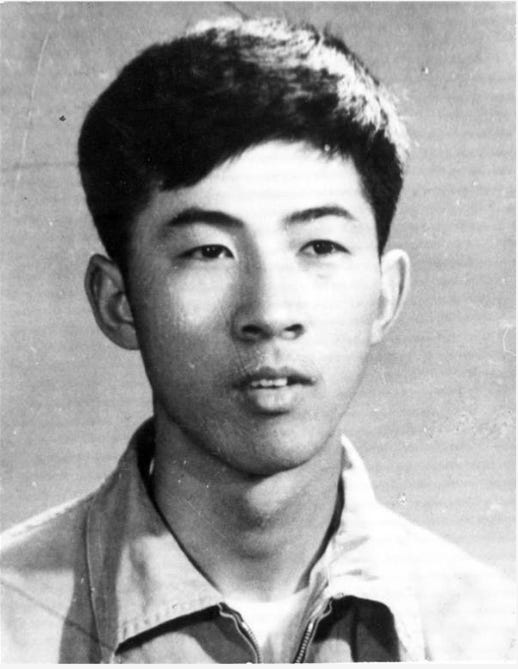
值得一提的是,不平本身也是文革期间的一个抗争者。1972年5月24日,当时还是中学生的不平(许绍吉),在上海市人民广场贴出一份长达22页的大字报《真理是有阶级性的吗》,在这篇文章中,他详细地论证了真理并没有阶级性——中共否定自由民主的一整套话术,是给二者打上阶级的标签,作者从否定真理的阶级性出发,来推出自由和民主没有阶级性的结论,并表达对思想自由、言论出版自由的认同与追求。李逊所著的《革命造反年代》一书,其中第38章《另类思潮,来自边缘的思索》(参见《记忆》杂志118期)中,就用一节专门介绍了许绍吉的思考与行动。
这份大字报当时只贴出半天就被撕掉,作者当时另外写的《论自由的阶级性》等几篇则根本没有机会张贴出来。这些观点在当时的影响非常小,但这种思想文本曾经存在,就是一个很重要的历史事实。今天,通过不平编著的这本书,我们也能看到,即使暴虐如文革,个体自觉而形成的抗争也并非孤立事件,而是如一条看不见的河流,贯穿其中。这是今天我们回看这段历史时,不能忽视,也能因此鼓舞起信心的一个事实。
本期推荐档案与延伸阅读:
【本文为中国民间档案馆首发,转载时请务必在正文之前注明“本文首发于中国民间档案馆”,并加上原文在中国民间档案馆网站或者中国民间档案馆Substack的链接。】
【作者观点不代表中国民间档案馆立场。】
Speaking Out While the Tyrant Still Lives: A Valuable Archive of Civic Resistance During the Cultural Revolution
By Hu Ping
On the occasion of the 60th anniversary of the Cultural Revolution, Chengjia Publishing in the United States released Documentary Record of Civic Resistance During the Cultural Revolution this June. Arranged chronologically, the book is a collection of historical materials documenting grassroots resistance in China. Its sources include local gazetteers, court judgments, newspapers, and other original written records. Organized along a timeline, it reconnects scattered fragments of popular resistance preserved in different kinds of documents, revealing both the continuity of civic resistance during the Cultural Revolution and its historical trajectory.
1
Documentary Record of Civic Resistance During the Cultural Revolution consists of two volumes totaling 947 pages and was compiled by Bu Ping (the pen name of Xu Shaoji).
Although I have never met Bu Ping in person, I read his books and articles many years ago and also came across introductions to his work by others. One example is Dr. Yin Hongbiao’s The Footprints of the Missing: Youth Thought During the Cultural Revolution, which devotes eight pages to him. We belong to the same generation. Before the Cultural Revolution, we were both third-year high school students—he attended the affiliated high school of Tongji University in Shanghai. During the Cultural Revolution, both of us began to think independently and critically, calling for freedom of thought and freedom of expression. After the Cultural Revolution ended, we both entered university, went on to graduate school, and eventually came to the United States. For many years, Bu Ping has devoted himself to research on the Cultural Revolution and to uncovering its historical materials, with a particular focus on civic resistance during that period—a subject that has also long concerned me.
“Amid the raging storms of history, to search for China’s conscience and backbone. “This is how Bu Ping described his original intention in publishing this book.
The Cultural Revolution was a catastrophe that swept across China. In those bloody years, when the cult of personality spread unchecked and ordinary people were silenced by fear, the thoughts and voices of the Chinese people were subjected to unprecedented repression. Yet Chinese people were not all mindless followers or spineless conformists. Faced with the “Six Articles on Public Security”—the Several Provisions on Strengthening Public Security Work During the Great Proletarian Cultural Revolution, issued in January 1967—and a succession of cruel and repressive policies, a number of courageous individuals with integrity, conviction, and independent minds stepped forward. Even if their voices were as faint as the buzzing of mosquitoes, they still uttered the firmest possible “No” to an age of violence. Some endured torture without yielding, faced imprisonment without fear, and even gave their lives, leaving behind enduring examples of resistance to tyranny.
Historical materials on dissent during the Cultural Revolution have appeared in several earlier publications. Among the most important are the following:
Yu Xiguang, Though Humble, I Dare Not Forget My Country: A Collection of Letters Written During the Cultural Revolution (Hunan People’s Publishing House, 1989). This volume collects petitions, letters, and memorials written by ordinary people—mostly rank-and-file officials, students, intellectuals, and common citizens—to higher authorities, the central government, or Mao Zedong himself. Most of these writings criticized mistaken Cultural Revolution policies, factional armed struggles, persecution of officials, and related issues, while also offering suggestions for reform.
Song Yongyi and Sun Dajin (eds.), The Cultural Revolution and Its Heretical Currents of Thought (Tianyuan Book House, Hong Kong, 1997). This volume brings together representative writings of heterodox thought from the Cultural Revolution period, accompanied by scholarly analysis tracing the emergence and development of these intellectual currents.
Yin Hongbiao, The Footprints of the Missing: Youth Thought During the Cultural Revolution (The Chinese University of Hong Kong Press, 2009). This work excavates and reconstructs the history of unofficial thought during the Cultural Revolution, systematically examining the evolution of socio-political ideas among Chinese youth and highlighting the significance of these thinkers in the intellectual history of contemporary China.
Song Yongyi, From Mao Zedong’s Supporters to His Opponents: Documentary Archives of Heterodox Thought During the Cultural Revolution (Vols. I & II, Guoshi Press, Hong Kong, 2015). This work presents ninety-three of the most important documents representing heterodox thought during the Cultural Revolution and explores the intellectual transformation of the Red Guard generation from fervent supporters of Mao Zedong into his opponents.
Song Yongyi, Collected Documentary Archives of Civic Dissent During the Cultural Revolution (Vols. I & II, Guoshi Press, Hong Kong, 2018). This collection includes personal documents produced by nearly seventy dissidents who challenged the official regime during the Cultural Revolution, including anonymous leaflets, private letters, diaries, prison manuscripts, and other materials.
Also deserving special mention is Wang Youqin’s Victims of the Cultural Revolution: An Investigative Record of Persecution, Imprisonment, and Killing (Open Publishing, Hong Kong, 2004). Through years of interviews and research, the author painstakingly documents the names and experiences of 659 ordinary people who were persecuted to death during the Cultural Revolution. By telling the story from the victims’ perspective, the book confronts the official narrative’s neglect of the suffering endured by ordinary people.
2
How, then, does A Documentary Record of Civic Resistance During the Cultural Revolution differ from the books mentioned above?
First of all, this book places great importance on speaking out. The writings collected here were not private exchanges among family and friends, nor were they works hidden away in desk drawers. They were made public in one form or another at the very time they were written. As someone who lived through the Cultural Revolution, I, like the book’s editor Bu Ping, can understand the irrepressible impulse that filled the hearts of these writers:
Speak out. We must speak out. They had to speak out while tyranny was still raging. They had to speak out while the tyrant was still alive. Better to speak out and die than to live in silence.
Another distinguishing feature of this book is that it includes not only well-known figures and famous writings, but also a great many little-known individuals and their writings. In 2019, Chengjia Publishing released the three-volume Martyrs of the Cultural Revolution, also edited by Bu Ping, which profiled 170 heroes and martyrs who resisted during the Cultural Revolution. A Documentary Record of Civic Resistance During the Cultural Revolution contains the writings of more than two hundred citizens who resisted during that period. The two books inevitably overlap in some respects, but the latter includes many more individuals and has a different emphasis.
Martyrs of the Cultural Revolution may be regarded as a collective biography of those heroes and martyrs who openly resisted during the Cultural Revolution, whereas A Documentary Record of Civic Resistance During the Cultural Revolution focuses on preserving the texts produced by those who resisted. It is more like a chronological archive of resistance writings, directing readers’ attention to the original documents of protest that have survived.
The task of locating and preserving these original writings was extraordinarily difficult. I, too, was a participant in resistance, and I know from experience that when a person begins to resist, his greatest concern is not yet the risks he himself will face, but how to spread his voice as widely as possible and let as many people as possible hear it.
Typically, a big-character poster you put up or mimeographed leaflets you distribute would be torn down or confiscated before many people had the chance to read them. Once you were arrested and sentenced, the trial was, as a matter of course, conducted in secret. Official notices issued by the authorities would describe the “crimes” of prisoners of conscience only in the vaguest terms, with formulaic phrases such as:
“The criminal has consistently harbored reactionary thinking and viciously attacked the Party and the Great Leader.”
Nothing more.
An authoritarian regime wants people to know only that certain ideas are dangerous and criminal, thereby making an example of those who express them. At the same time, it is determined to prevent the public from learning what those ideas actually are. Even when resisters were paraded through the streets or taken to the execution ground, their throats were seized so that they could not speak.
In this way, the ideas they sought to express at the cost of their own lives—and the heavy price they paid for expressing them publicly—were completely silenced by the authorities. As a result, their sacrifice was prevented from acquiring the meaning it should have had.
That, above all, is the greatest tragedy.
Yet in the end, thanks to the efforts of dedicated individuals, later generations have been able to hear at least some of the voices of those who resisted. Among the writings of more than two hundred citizens collected in A Documentary Record of Civic Resistance During the Cultural Revolution, there are a few authors and texts that I knew about at the time—for example, Yu Luoke’s “On Class Origins” in Beijing and the famous big-character poster by Li Yizhe in Guangzhou. There are also a handful that I came to know only after the Cultural Revolution ended, such as Wang Rongfen, Zhang Zhixin, and Wang Shenyou. But I learned about most of the others only by reading this book compiled by Bu Ping. They were ordinary people scattered across different parts of China.
Among them were many peasants who voiced ideas of resistance. One was Du Shanmei, a farmer from Shiwan Production Brigade, Lianjiang Commune, Anyuan County, Jiangxi Province. He posted a big-character poster entitled “Rebelling Against ‘Long Live’”, arguing that the slogan “Long Live” was an honorific reserved for emperors in China’s feudal dynasties, who had always been the mortal enemies of the people. For this he was branded an active counterrevolutionary (Vol. I, p. 120). Another was Zhuang Qiuhan, an accountant at the Yancang Supply and Marketing Cooperative in Nanhui County, Shanghai. He distributed mimeographed leaflets signed by the “Anti-Mao-Lin Detachment” to thirty-eight work units across the county, enumerating the crimes of the Cultural Revolution. He was sentenced to death (Vol. I, p. 157).
Voices of dissent emerged throughout the country. In Dongchuan, Yunnan Province, Shi Kun and seven other employees of the local grain bureau frequently gathered to discuss current affairs. They criticized Mao Zedong for practicing dictatorship and condemned the Communist Party for violating its own Constitution, which guaranteed freedom of speech, publication, and assembly while branding anyone who exercised those rights as a counterrevolutionary. As a result, the eight men were designated a counterrevolutionary group, and the three alleged leaders received prison sentences of fifteen, ten, and five years respectively (Vol. II, p. 645). In Chengdu, Zhang Jiankui, an accountant in the Wangjiaba Rubber Production Group, posted a handwritten leaflet entitled “A Call for Deep Reflection by the People of the Entire Nation.” In it, he openly denounced the small clique headed by Jiang Qing, including Zhang Chunqiao, Yao Wenyuan, and Wang Hongwen. He was convicted of counterrevolutionary crimes (Vol. II, p. 875).
3
Of course, the records of these more than two hundred citizens are far from complete. There were many more people who resisted, and many more writings that have never been found. Some records may still lie buried in dusty files kept by the public security authorities. Others may have vanished forever, leaving no trace behind.
I can only imagine how much effort Bu Ping devoted to locating and rescuing these suppressed and forgotten original texts. I am also reminded of Wang Youqin, who likewise, through her own tireless efforts, dedicated herself to preserving the memory of the Cultural Revolution. Wang records the victims; Bu Ping records the resisters. Both are equally important. They complement one another, and neither can be dispensed with. It is no exaggeration to say that Bu Ping’s contribution is no less significant than Wang Youqin’s.
It is also worth mentioning that Bu Ping himself was a participant in resistance during the Cultural Revolution. On May 24, 1972, while still a middle school student, Bu Ping (Xu Shaoji) posted in Shanghai’s People’s Square a twenty-two-page big-character poster entitled “Does Truth Have a Class Character?” In this essay, he argued in detail that truth has no class character. The Chinese Communist Party’s entire rhetorical framework for denying freedom and democracy, he wrote, rested on assigning both concepts a so-called class character. Beginning with the proposition that truth itself has no class character, he went on to conclude that freedom and democracy likewise have no class character, expressing his support for and pursuit of freedom of thought and freedom of speech and publication. In Chapter 38 of Li Xun’s The Age of Revolutionary Rebellion, entitled “Alternative Currents of Thought: Reflections from the Margins” (also published in Remembrance, Issue No. 118), this episode is discussed in a dedicated section.
That big-character poster remained on display for only half a day before it was torn down. Several other essays that Xu Shaoji wrote, including “On the Class Character of Freedom,” were never even given the chance to be posted. At the time, these writings had very little influence. Yet the simple fact that such texts existed is itself an important historical fact.
Through Bu Ping’s book, we are also able to see that throughout the ten years of the Cultural Revolution, acts of resistance arising from individual moral awakening were not isolated incidents. Rather, they formed an invisible river running beneath the surface of that turbulent decade. As we look back on this period today, this is a historical reality that must not be overlooked—and one that should also inspire confidence for the future.
Recommended archives:
Footprints of the Missing: Trends of Youth Thought During the Cultural Revolution
Documentary Records of Civic Resistance During the Cultural Revolution
Heterodox Thoughts during the Cultural Revolution
[This article first appeared in China Unofficial Archives. When reposting, please ensure that the following is included at the beginning of the reposted text: “This article was first published by the China Unofficial Archives,” accompanied by a link to the original article on the China Unofficial Archives website or Substack.]
[The views expressed by the author of this article do not necessarily reflect the position of the China Unofficial Archives.]
題目取得很好:在暴君活着的时候就喊出反对:文革中的公民抗争。
我也也有一本書,類似“文革中的公民抗争”,不知道如何上傳?