

《理大围城》:抗议的火光已熄,但镜头仍旧记忆
Inside the Red Brick Wall: The Flames of Protest Are Extinguished, But the Camera Remembers

作者:李维
By Li Wei
The English translation follows below.
时间是记忆最大的敌人。香港2019年的社会运动,转眼已过去六年,许多当时一手的媒体直播早已散失,多家独立媒体近年来都迫于政治压力而关闭,社交媒体上两极分化的碎片化叙事,更是有意无意地重构了公众的认知。
六年前的11月中旬,香港多所高校的校园成为战场,警民冲突在香港理工大学内部及周边尤为激烈,警方包围校园近两周,大量示威者被捕。如今,理大冲突的火光已熄,无论是亲历者还是旁观者,还有多少人清晰地记忆着当时的场景?
作为一个近距离观察2019年香港社会运动的大陆人,我感受到了这种认知的断裂之深:许多认同民主自由价值观的朋友,依然难以理解当时“勇武派”抗争者为何要选择激进的“以武制暴”。即便查阅第三方资料,如维基百科的“香港理工大学冲突”、“香港中文大学冲突”、“香港黎明行动”、“破晓行动”、“晨曦行动”、“曙光行动”等词条,我们读到的也多是关于暴力冲突的描述。这种困惑在面对2019年11月香港高校校园内的火光时,往往会变成一种本能的排斥与不屑。
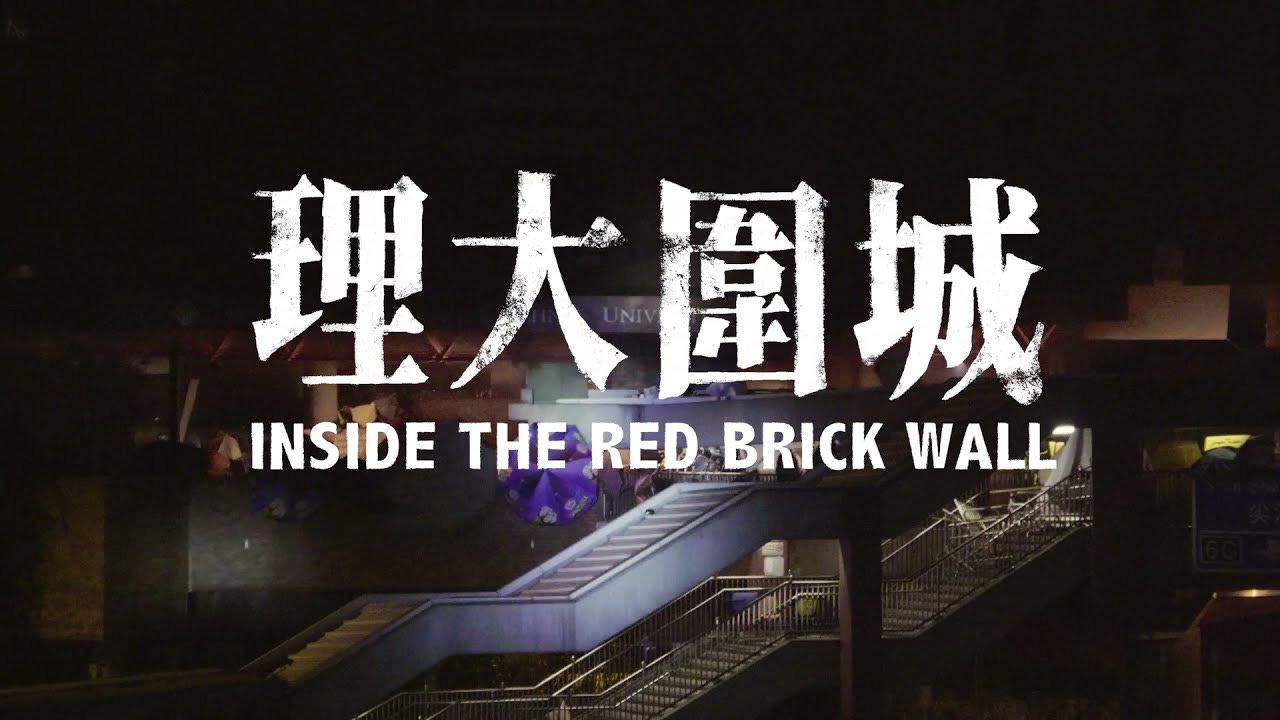
正是在这样记忆的迷雾中,纪录片《理大围城》为人们提供了宝贵的一手资料。这部影片不加渲染,拒绝宏大叙事,记录了运动中的个体和细节,将观众带回香港理工大学的红墙内,一同经历那个特殊的历史时刻。要看懂《理大围城》中年轻抗争者的处境,必须先理解2019年香港社会运动的宏观背景。
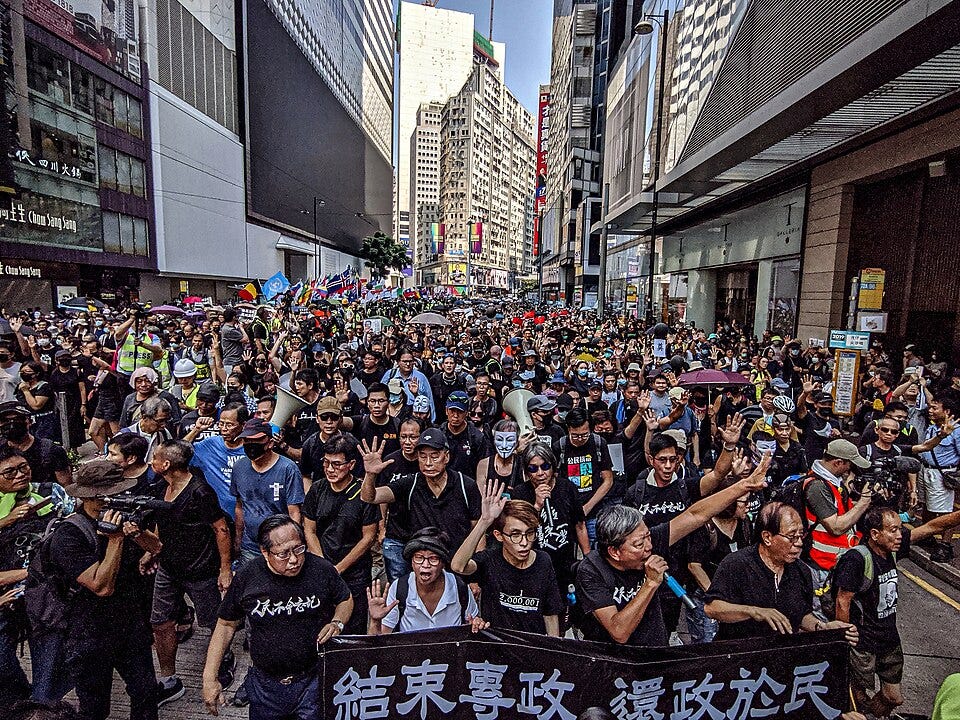
这场运动始于2019年6月,最初是为了反对香港政府修订《逃犯条例》,该条例允许将嫌疑人引渡至中国大陆受审。尽管有上百万人参与和平游行,政府初期的强硬态度和警方的武力驱散,导致部分示威者认为和平手段已无法奏效。
于是,运动中逐渐分化出一支被称为“勇武派”的力量,他们主张用更为激进的手段,包括破坏公共设施和与警方正面对抗,来迫使政府回应民间提出的“五大诉求”,其中包括撤回修例和落实真普选。到了2019年下半年,向来推崇“和平、理性、非暴力”(“和理非”)的香港民主派与“勇武派”形成了独特的互助关系,被称为“和勇不分”,即和平示威者在道义和后勤上支持前线“勇武”抗争者,而“勇武”抗争者则试图通过“以武制暴”来确保运动不因警暴而收场。
2019年11月的校园冲突,正是这种对抗升级的顶点。当月发生的港科大学生周梓乐坠落身亡事件,成为局势恶化的直接导火索。“勇武派”以此为由,号召在11月11日发动“黎明行动”,意图在天亮前通过瘫痪交通来强制实现全港“三罢”——罢工、罢课、罢市。
抗议者选择占领大学校园,基于战略考量:香港中文大学毗邻连接新界与深圳的交通大动脉——吐露港公路和东铁线;而香港理工大学则紧邻连接九龙与港岛的核心通道之一——红磡海底隧道。抗议者试图通过控制校园,向这些交通干道投掷杂物,从而威胁香港的经济命脉以向政府施压。
面对抗争者的行动,香港警方打破了常规。大学校园在法律和传统上通常被视为警方的禁区,除非接获报案或取得搜查令,否则警方不得擅自进入。然而,抗争者对校园的占领和对交通的阻塞成为了警方强力介入的理由。
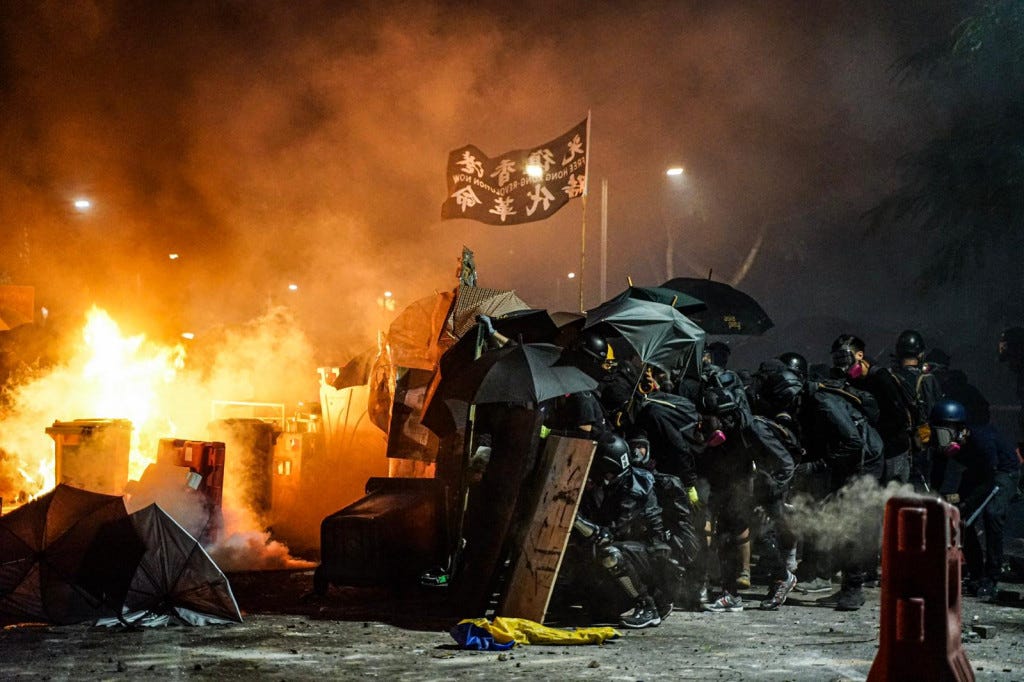
11月12日晚,中大“二号桥”发生了标志性的激烈冲突,警方发射了逾2000发催泪弹和橡胶子弹,抗议者则主要以汽油弹回击。当警察在夜间撤离后,一些抗议者误判这是一场战术胜利,随即信心满满地转战香港理工大学。不料,香港警方将理大校园包围,校园内的抗争者进退两难,直到11月28日警方才解除封锁。
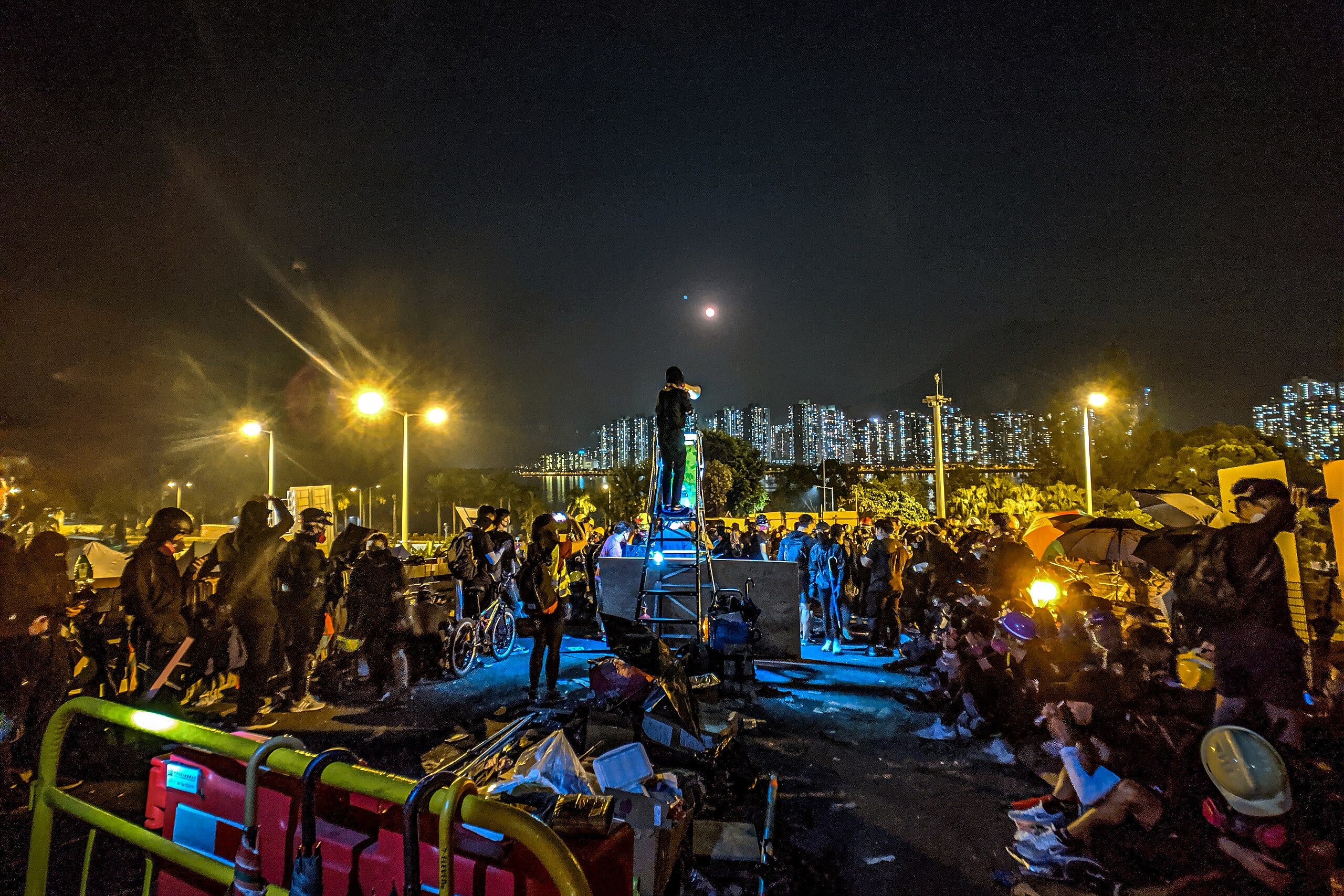
《理大围城》没有试图铺陈上述复杂的历史背景,而是将叙事焦点精确地锁定在危机最尖锐的时刻:从2019年11月17日警方彻底包围校园,将抗议者困成“瓮中之鳖”,到次日晚多名中学校长进入校园试图带离学生的最初两天。
影片由“香港纪录片工作者”匿名制作,绝大部分镜头中抗议者的面部被打上马赛克(为了确保被捕人士不被警方“消失”,有抗议者被捕的镜头中,被捕者的面部在影片中清晰显现),这种去个人化的处理反而强调了这是一种群体的共同命运。影片不进行道德审判,不提供全知视角,只是带领观众进入那个封闭、压抑且充满恐惧与绝望的红砖围墙之内。
包围之初,年轻的抗争者们颇有兴致,与校外的警察喊话,还用扩音器放着辱骂警察的说唱。而警察也用喇叭向校内的抗争者劝降,还放出《十面埋伏》等歌曲。但这和香港2019年的其他警民冲突一样,根本不是一场对等的冲突。警察有着充足的支援,拿着高额的加班费,有着装甲车、水炮车、“声炮”、催泪弹、橡皮子弹以及真枪实弹。而抗争者的攻击性武器主要是汽油弹(在《理大围城》中也出现了弓箭),而其它装备主要是防卫性的雨伞和放毒面罩。
很快,抗争者们意识到了自己的困境:冲出重围意味着直接遭到逮捕和暴力对待;尝试跳下天桥或钻下水道逃生则面临伤亡的风险;选择投降登记则意味着日后法律的追责和长期的牢狱之灾;而留守校园则要忍受精神崩溃和弹尽粮绝的折磨,寄希望于渺茫的“围魏救赵”,即校园外的抗争者试图从外围冲破警察的封锁。
到了理大围城的第二晚,有许多中学的校长被警方允许进入校园,带领抗议的学生走出校园。警方允许抗议者当晚回家,但必须与警方登记。虽然有抗议者反对校长的介入,但是许多学生默默地选择和校长们离开。
最令人难忘的场景,要属影片最后两个少年在台阶上犹豫不决的样子。他们看着下方已经撤离“投降”的学生,又时不时地回头看留守的战友,不知道自己究竟应该做出什么选择。个体面临的进退维谷的处境,也是所有香港人在2019年需要做出的抉择。
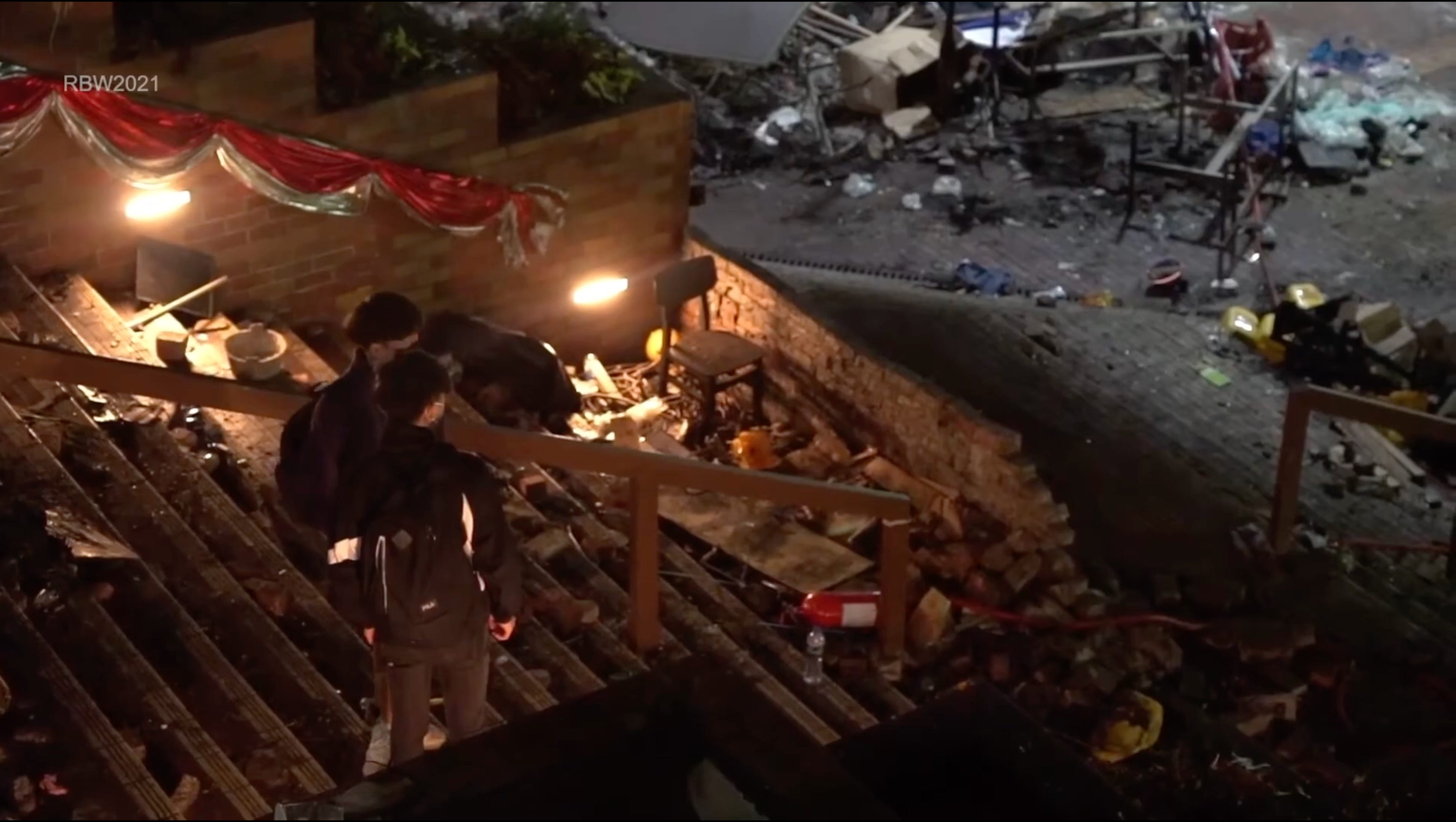
《理大围城》没有解答——也没有试图解答——许多人对“勇武”的疑惑:为什么“勇武派”造成破坏,民主派却选择“和勇不分”?为什么“勇武派”失策被围攻,但许多香港民众依然同情年轻的抗争者,而压倒性的民意,使民主派在2019年11月24日的香港区议会选举中横扫全港十八区的大多数席位?
这些问题的答案,以及香港2019年社会运动的历史意义,恐怕需要更长的历史维度才能显现。制作《理大围城》的“香港纪录片工作者”记录了可能被噤声的视角,抢救了容易被忘却的记忆,为帮助后人理解香港的历史尽到了一份责任。
与《理大围城》相对的,是中国官方针对香港民主运动的一系列话术与叙事。早在2016年,新华社发布新闻报道禁用词中就特别加入了对于香港抗争运动的“规范”称呼:
对港澳反对派自我褒扬的用语和提法要谨慎引用。如不使用“雨伞运动”的说法,应称为“非法‘占中’”或“违法‘占中’”;不称“占中三子”,应称为“非法‘占中’发起人”,开展舆论斗争时可视情称为“占中三丑”;不称天主教香港教区退休主教陈日君等为“荣休主教”,应称为“前主教”。
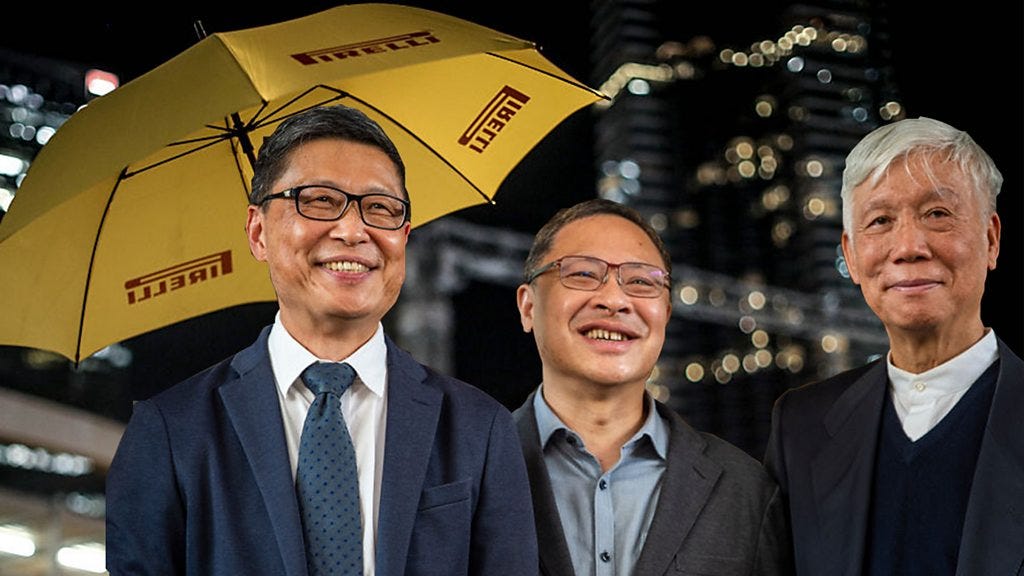
而2019年,反修例运动在一开始就被官方定性为“暴动”,致使运动过程中的五大诉求之一就是要求港府撤回“暴动”认定。对于反修例运动中的参与群体,中国新闻中的常用指代语包括“暴徒”、“恐怖分子”、“乱港分子”。
因为中国大陆的信息封锁和无孔不入的新闻审查,不难想象,大部分中国公众对这场运动的认知跟上述官方叙事出入不会很大。而在当下,因为2020年国安法的实行,中央对香港言论的全面镇压,在香港曾经存在过的与官方话语相异的叙事和记录,已经很难进入中文公众视野。
可见,官方深谙孔子“必也正名乎”的统治理论,所谓“名不正,则言不顺也”。权力自史以来就对语言充满警惕,因为独立的叙事具有对正统的破坏力量。
随着官方的“禁用词”和定性,针对香港社会运动的记忆改造工程早已开启。如果持续下去,多年后的大陆和香港公众,也会逐渐因此而丧失对整场运动的理解的可能性,可能进而演化为漠不关心。
在这样的语境下,我们需要看到2019年在运动现场、在事件发生的中心,“香港纪录片工作者”在《理大围城》等纪录片中记录下不同个体、侧面、瞬间的价值。这些记录并不是试图定义整场运动的正义性、历史意义和结论,但会保存下被官方话语覆盖、屏蔽、湮没的事实,让独立的记忆成为真正的可能。
本期推荐档案:
【本文为中国民间档案馆首发,转载时请务必在正文之前注明“本文首发于中国民间档案馆”,并加上原文在中国民间档案馆网站或者中国民间档案馆Substack的链接。】
【作者观点不代表中国民间档案馆立场。】
Inside the Red Brick Wall: The Flames of Protest Are Extinguished, But the Camera Remembers
By Li Wei
Time is memory’s greatest enemy. Six years have passed since the 2019 Hong Kong social movement. A lot of the original, raw coverage has been lost to history, several independent news outlets have been forced to close in recent years due to political pressure, and the polarized, fragmented narratives shared on social media have reshaped public understanding of the movement.
In mid-November six years ago, multiple university campuses in Hong Kong became battlefields. The conflict between police and protesters was especially fierce inside and around the Hong Kong Polytechnic University (PolyU). The police maintained a siege of the campus for nearly two weeks, arresting many demonstrators. The fires of the PolyU clash have long since died down, but how many people—participants or onlookers—still retain a clear memory of those events?
As a mainland Chinese person who observed the 2019 Hong Kong social movement up close, I sensed this gap in understanding. Many of my friends from mainland China who identify with democratic and liberal values still struggled to comprehend why the radical faction, known as the “Valiants,” chose aggressive tactics, such as using force to counter police brutality. Even when consulting third-party references, such as the Wikipedia entries for the conflicts, we mostly encounter descriptions focused on violent confrontation. When facing the images of fire on Hong Kong university grounds in November 2019, this confusion often morphed into an instinctive rejection and contempt.
It is within this mist of manufactured memory that the documentary Inside the Red Brick Wall offers crucial first-hand evidence. The film avoids melodrama and rejects sweeping narratives, instead documenting the individuals and intimate details of the movement. It transports the audience back inside PolyU’s distinctive red walls to collectively experience that singular historical moment. To fully grasp the predicament of the young protesters depicted in Inside the Red Brick Wall, one must first understand the broader context of the 2019 Hong Kong social movement.
The movement began in June 2019, initially in opposition to the Hong Kong government’s proposed amendments to the Fugitive Offenders Ordinance, which would have allowed suspects to be extradited to mainland China for trial. Despite over a million people participating in peaceful marches, the government’s initial uncompromising stance and the police’s forceful dispersal methods led some demonstrators to conclude that non-violent means were ineffective.
Consequently, a force known as the Valiants gradually emerged within the movement, advocating for more radical measures. These included the destruction of public property and direct confrontation with the police, intended to pressure the government into meeting the “Five Demands,” which featured the formal withdrawal of the bill and the implementation of genuine universal suffrage.
By the latter half of 2019, Hong Kong’s democratic camp—traditionally committed to its style of “Peaceful, Rational, Non-Violent”—adopted a unique, mutually supportive relationship with the Valiants, a concept known as “Do Not Split.” Peaceful demonstrators offered moral and logistical backing to the frontline Valiants, who, in turn, sought to ensure the movement would not be crushed by police brutality.
The campus conflicts in November 2019 represented the peak of this escalating opposition. The death of college student Chow Tsz-lok from a fall that month served as the immediate spark that worsened the crisis. Citing this event, the Valiants called for the “Dawn Action” on November 11, aiming to paralyze traffic before daybreak and force a city-wide suspension of work, school, and business.
Protesters strategically chose to occupy university campuses. The Chinese University of Hong Kong (CUHK) is situated next to the Tolo Harbour Highway and the East Rail Line, both key transport arteries connecting the New Territories to Shenzhen; similarly, PolyU is adjacent to the Cross-Harbour Tunnel, a vital link between Kowloon and Hong Kong Island. By controlling the campuses, protesters sought to throw objects onto these thoroughfares, threatening Hong Kong’s economic lifelines to pressure the government.
In response to the protesters’ actions, the Hong Kong Police Force disregarded established protocol. University campuses are conventionally and legally viewed as off-limits to police, who typically cannot enter without a formal report or a search warrant. However, the protesters’ occupation of the campuses and the resulting traffic obstruction were cited as justification for a forceful police intervention.
On the night of November 12, a significant and intense clash occurred at CUHK’s No. 2 Bridge. Police launched over 2,000 rounds of tear gas and rubber bullets, while protesters’ primary defense was Molotov cocktails. When the police retreated that night, some protesters misjudged it as a tactical success and, full of confidence, shifted their efforts to PolyU. Unexpectedly, the police surrounded the PolyU campus, leaving the protesters inside trapped until the blockade was finally lifted on November 28.
Inside the Red Brick Wall avoids detailing this complex historical context, focusing its narrative precisely on the most critical phase: the period beginning on November 17, 2019, when the police entirely sealed off the campus and trapped the protesters, up to the following evening, when several secondary school principals were permitted to enter and attempt to lead their students out.
The film was created anonymously by the “Hong Kong Documentary Filmmakers.” In most scenes, the faces of the protesters are blurred with a mosaic (though the faces of arrested individuals are clearly visible to prevent their “disappearance” by police). This deliberate de-personalization ironically highlights their shared, collective destiny. The film refrains from moralizing or offering an all-knowing perspective, instead guiding the audience into the confined, oppressive space within the red brick walls, filled with fear and despair.
At the start of the siege, the young protesters were quite spirited, yelling at the police outside and using megaphones to play aggressive rap music. The police, in turn, used loudspeakers to urge the protesters to surrender, even playing music like Ambush from Ten Sides. However, similar to other police-protester conflicts in Hong Kong in 2019, this was fundamentally an unequal clash.
The police had unlimited reinforcements, earned high overtime pay, and were equipped with armored vehicles, water cannons, acoustic devices, tear gas, rubber bullets, and live ammunition. The protesters’ main offensive tools were Molotov cocktails (though bows and arrows also appear in Inside the Red Brick Wall), while their other gear was largely defensive, consisting of umbrellas and gas masks.
The protesters soon recognized the gravity of their situation: breaking out meant immediate arrest and violent handling; attempting to escape by jumping from bridges or using storm drains carried severe risks of injury or death; choosing to surrender and register meant future legal prosecution and long prison terms; and remaining on campus involved enduring mental exhaustion and dwindling supplies, clinging to the faint hope that protesters from outside the campus would attempt to break the police cordon.
By the second night of the PolyU siege, the police allowed numerous secondary school principals to enter the campus and escort their protesting students out. The police permitted the protesters to go home that night, provided they registered their identities. Though some protesters objected to the principals’ intervention, many students quietly chose to leave with them.
The most poignant moment in the film is arguably its final scene, showing two young men hesitating on a staircase. They look down at the students who have already retreated and left, then occasionally glance back at their comrades still holding out, agonizing over what choice to make. This individual dilemma of being caught between impossible choices mirrored the decision facing all people in Hong Kong in 2019.
Inside the Red Brick Wall does not attempt to resolve many people’s questions about the Valiants: Why did the democratic camp support “Do Not Split” despite the Valiants’ causing damage? Why, even after the “Valiants’” tactical failure at PolyU, did many Hong Kong residents still sympathize with the young protesters? And how did this overwhelming public sentiment lead the democratic camp to sweep the vast majority of seats across all eighteen districts in the Hong Kong District Council elections on November 24, 2019?
The answers to these questions, and the ultimate historical meaning of the 2019 Hong Kong social movement, will likely only emerge over a longer historical timeline. By documenting perspectives that could be suppressed and rescuing memories prone to fading, the “Hong Kong Documentary Filmmakers” who produced Inside the Red Brick Wall fulfilled a vital duty in helping future generations understand Hong Kong’s history.
This is especially important given the way the Chinese authorities construct official narratives and rhetoric about Hong Kong. As far back as 2016, a list of forbidden terms for news reports published by Xinhua News Agency specifically included standardized labels for the Hong Kong protest movement:
Be careful when citing language used by the Hong Kong and Macao opposition to praise themselves. For instance, do not use the term “Umbrella Movement”; it should be called “illegal ‘Occupy Central’” or “unlawful ‘Occupy Central’”; do not refer to the “Occupy Central Trio,” but instead call them the “initiators of illegal ‘Occupy Central,’” and when engaging in public opinion battles, they may, if appropriate, be referred to as the “three disgraces of Occupy Central.” Furthermore, do not call retired figures like Cardinal Joseph Zen “Bishop Emeritus,” but rather “former bishop.”
By 2019, the anti-extradition bill movement was immediately officially designated a “riot,” which is why one of the Five Demands was for the Hong Kong government to retract this classification. Common official terms used in Chinese news to refer to participants in the anti-extradition bill movement include “thugs,” “terrorists,” and “elements sowing chaos in Hong Kong.”
Given the information blockade and pervasive news censorship in mainland China, it is reasonable to assume that many among the Chinese public’s perception of the movement adheres closely to the official narrative. Moreover, with the implementation of the National Security Law in 2020 and the central government’s total suppression of speech in Hong Kong, alternative narratives and records that once existed in the city are now highly unlikely to reach the Chinese public sphere.
Evidently, the governing authorities understand Confucius’s theory of governance: “If names are not correct, language is not in accordance with the truth of things.” Since ancient times, power has been wary of language because independent narratives possess a potent power to undermine orthodoxy.
With the government’s list of forbidden words and official designations, the project to engineer the memory of the Hong Kong social movement is already in motion. If this continues, years from now, the public in both the Mainland and Hong Kong may gradually lose the capacity to understand the entire movement, potentially leading to widespread indifference.
In this context, we must recognize the immense value of the different individual perspectives, facets, and moments documented by the “Hong Kong Documentary Filmmakers” in Inside the Red Brick Wall and similar works, recorded on-site, at the heart of the events in 2019. These records do not attempt to definitively judge the movement’s righteousness, historical significance, or conclusion. Instead, they preserve the facts that are being obscured, shielded, and erased by official discourse, thereby making independent memory truly possible.
Recommended archive:
[This article first appeared in China Unofficial Archives. When reposting, please ensure that the following is included at the beginning of the reposted text: “This article was first published by the China Unofficial Archives,” accompanied by a link to the original article on the China Unofficial Archives website or Substack.]
[The views expressed by the author of this article do not necessarily reflect the position of the China Unofficial Archives.]
這部影片對我有特殊的意義。22年末,正值大陸公民運動爆發的時候,我在灣區參加了香港學生組織的燭光會和影片播放。看到現場放著我熟悉的歌,絕境裡的學生們都不願放棄自己的手足,整個人都在發抖,我聽到周圍人們吸鼻子,擦眼淚,感覺全場不認識的人都凝結在一起。
那是我第一次走出家門參加社會活動,從那之後想方設法掙脫大陸敘事的洗腦,如今三年了。我記得19年的時候我深信不疑香港充滿了暴徒,希望國家分裂,為了這份認知,到今天我都認為為自由民主盡微薄之力是要償還的責任
Oh, and this should be added to the Hong Kong CCP tyranny takeover since Covid-1984, Jimmy Lai pronounced "guilty" of speaking truth to power:
Hong Kong tycoon Jimmy Lai found guilty under national security law
Lai, who turned 78 behind bars last week, was found guilty of two counts of conspiring to collude with foreign forces under the Beijing-imposed national security law, and a third count of sedition under colonial-era legislation.
https://hongkongfp.com/2025/12/15/breaking-hong-kong-tycoon-jimmy-lai-found-guilty-under-national-security-law/
And to December 2025 how many know 1,931 political prisoners in HK alone?
https://www.hkdc.us/political-prisoner-database