

香港记者:六四现场的记录者和记忆的传承者
Hong Kong Journalists: Chroniclers of June Fourth and Keepers of its Memory

The English translation follows below.
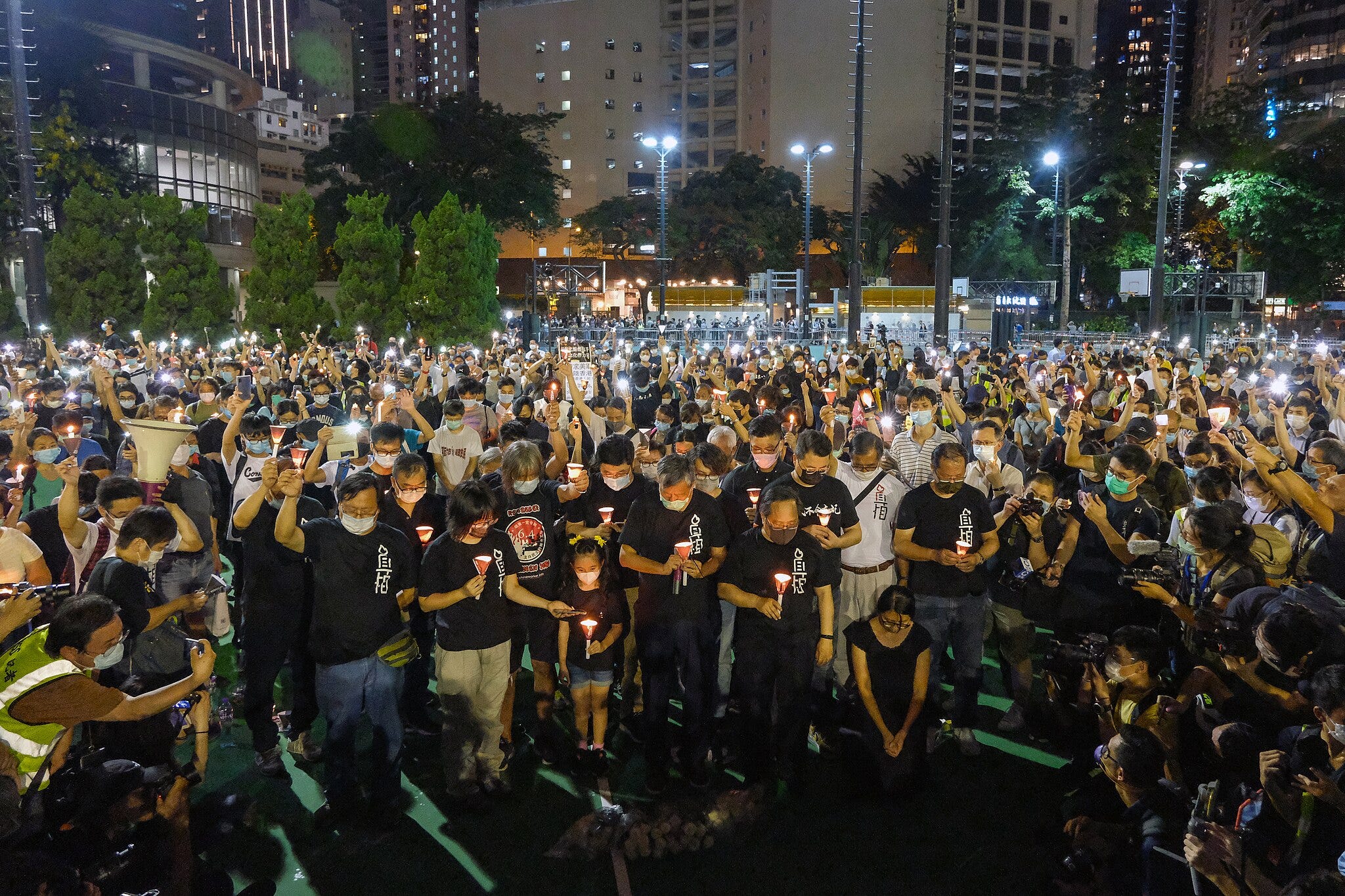
如今,香港的新闻业正受到越来越多的限制,而其中的一个重要风向标,就是每年对“六四事件”的纪念报道。在2020年之前,这些报道每年六月初都会出现于各大媒体;而在2020年之后,涉足这一话题已经需要莫大的勇气。
持续不断地回顾和纪念六四,是香港传媒曾经的重要传统。这桩发生在两千公里之外的事件,也影响了一整个世代的香港记者。
1989年春夏之交的京城,在广场上、人群中,来自香港的记者是一支特殊的力量。他们不像内地的记者那样面临重重束缚,只能在夹缝中寻求突破;又不似西方媒体记者始终是在报道一个遥远东方国度的“他们的故事”。和学生们一样黄皮肤、黑眼睛的香港记者,将这场学生运动不仅视为报道的对象,也看成了真正的“自己人的事情”。
由64名曾赴京采访1989年学生运动的香港记者撰写的《人民不会忘记:八九民运实录》当中,就直接记录了他们既是新闻工作者、又身为中国人的纠结心态——“在民族前途,大是大非的重要关头,如何能够使自己置之度外、保持冷静呢?”
当时,香港尚未回归,仍是英国殖民地。但是,香港记者们深知,这场学生运动的命运,和香港新闻界,乃至整个香港日后的命运都可谓息息相关。
现场与记忆
如今已经很难想象,当年的香港记者对于北上报道1989年的学生运动有多么强烈的热情。《人民不会忘记》一书中记载:除了被香港各家媒体机构正式派往北京的记者之外,还有不少香港记者“自掏腰包,不理家人和报馆禁令,赶赴北京作‘历史见证人’。”这些自费前往北京的记者“最多时达数十之众”。
在北京,香港记者的数百双眼睛见证了许多具体的历史场景,有激动和振奋的时刻,更有恐怖与伤心的景象。他们不仅在当时通过文字、广播、电视等形式记录下了这些场景,而且在此后的三十年里,不断地回忆和再现这些场景。正是当时的记录和后来的回忆,在很大程度上让六四成为整个香港持久关心的话题与集体记忆。
时任《星岛日报》记者的蔡淑芳,是当时最后一位撤出天安门广场的香港记者,她甚至在广场上写下了遗书。蔡淑芳后来出版了《广场活碑:一个香港女记者眼中的六四血光》一书,将自己的采访和之后的感怀结成集子。“活碑”这个比喻,恰好也总结了香港记者作为一个群体的意义。
值得一提的是,《广场活碑》这本书中不仅有对学生领袖和知识分子的专访,也有一个部分专门献给运动中的约两千名社会底层人士。他们有的没有留下姓名,更多的则是只有一两句话的介绍,但这依然是一份珍贵的记录,它显示出这场运动是一场真正的人民民主运动,并不只是学生和知识分子在“闹事”。而且,这些底层民众可能付出了比学运领袖更加惨重的代价。让他们不被历史遗忘,是这座“广场活碑”的一项重要贡献。
人性与党性
香港记者们不仅在记录历史,也在亲身经历历史。天安门广场清场后,他们为了自身的安全,也只好速速离开北京,而在这个紧张的过程中,记者们遇到了不少彰显人性的时刻。通过记者们后来的讲述,我们得以窥见一二。
例如,在《人民不会忘记》中,当时在亚视担任记者的谢志峰回忆起逃离北京时的场景。1989年6月5日,他和同事乘车赶往机场,不料却遇到数百人堵路。对方问:“你们什么人?”谢志峰紧张地如实回答:“香港记者。”对方又问:“广场上的事,看见了么?”谢回答:“都看见了。”
接下来的一幕,并不是他们因此被扣押或被惩罚,而是对方走上前来跟亚视的记者们说:“你一定要尽快将消息讲出去!我们帮你开路!”
到了机场,惊魂未定的众人又遭遇海关的询问:“你们是不是记者?”谢硬着头皮回答:“是。”海关问“有没有现场录像?”谢如实回答:“有。”
了解了他们身份的海关关员,并没有没收他们的录像胶片,而是在沉默了一秒之后说:“快走!”
那是一个没有互联网的年代,所有的采访素材都要通过实体的方式承载。当时在北京机场,许多人都在默默帮助记者们将素材运往海外。不少普通乘客都参与了这个协助运送的过程,因为大家都希望这些事实被看到、被留在历史当中。
包括《人民日报》在内的内地党报编辑记者对运动的参与,体现了他们作为公民的能动性,而不是新闻工作者对政权应有的忠诚。而香港的一家同样在共产党领导下的报纸——《文汇报》同样展现出了类似的精神。正如我们在《血洗京华实录:香港文汇报1989年特刊》当中读到的,《文汇报》的记者们在京现场采访,留下了大量的影像和文字资料,如实记录了运动的发展和清场的残酷,而这显然是对党的宣传路线的极大违背。
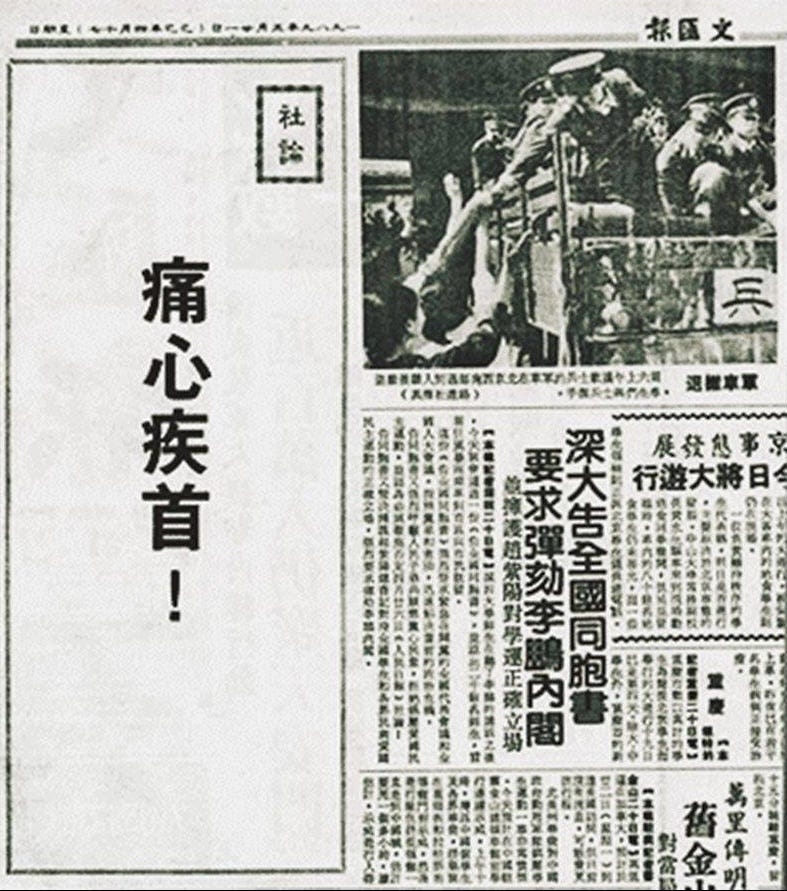
实际上,早在当年5月21日,香港《文汇报》就以开天窗形式发表社论,刊登了“痛心疾首”四个大字,回应戒严令。该报社社长李子诵、总编辑金尧如、副总编辑程翔后来均被免职,另有约三十名员工支持李社长而先后请辞。
真相与伦理
在讲述六四事件的时候,不少香港记者经常强调的一点是:整个事件太复杂了,而中共的政治又太不透明了,因此谁也没有把握说掌握了全部的真相,只能选择忠实地把自己看到的、听到的东西记录下来,并且期待当更多的信息被拼凑到一起之后,可以更接近真相一些。
在《人民不会忘记》当中,记者们还对当时传播的一些虚假信息(例如“李鹏下台”、“邓小平遭毒死”等)做了列举和反思。可以看出,记者们虽然在事件中都有自己强烈的倾向,但大家清楚,以符合专业伦理的方式去操作是重要的。
记者们将媒体错报虚假信息归结于市场竞争的缘故,并且更进一步,提出了另一项重要反思,那就是记者在这样的运动当中究竟如何自处。
书中这样记录:“随着学生从校园走上街头发动多次游行,北京的知识分子奋起响应,市民情绪高涨,记者也就受感染了。当游行队伍经过时,记者情不自禁地竖起‘V’字型手势致敬,或者将钱掉进学生的募捐钱箱。后来发展成向学生提供报纸,交流外界的讯息;或者自己掏钱请学生吃饭,送香烟给他们抽,与学生建立了友谊。
当五月十三日学生在天安门广场进行绝食静坐,以至后来戒严期间,香港记者几乎都站到了学生和知识分子的一边。有些记者曾招呼在广场坚守了多天的学生,到自己酒店的房间洗澡、更换衣服;也有些记者曾借出自己的房间让学生领袖开会或休息。部份更出谋献策,与采访对象的关系密切。”
这些对传统意义上记者身份的超越,虽然可以说当时情境下的一种自然发展,但它也令恪守专业主义的记者们警惕和反思。
蔡淑芳在《广场活碑》中也有类似的反思:“因我是来自香港的记者,被热烈招呼加入游行队伍,并受到学生们的保护。当我在首都新闻界的‘新闻自由’、‘要说真话’的横额下,和大伙一起进入示威现场的时候,我已意识到自己既难于抽离现场,又自然而然地卷入他们的行动。我在直接介入事件成为参加游行一分子,和作为记者坚持要作客观中肯报导这两者之间的角色重叠了。也许,在这个特定的历史时刻、这澎湃的时代洪流里,是无可避免的二而为一,难以置身事外地冷待事态的发展。”
这些对记者采访工作场景的侧面描述,同样是珍贵的历史素材,它揭示出历史记录者常常面对的张力。记录者不可能拔着自己的头发离开地面,以上帝视角俯瞰一切,何况当时正在发生的是攸关许多人性命和民族前途的关键事件。重要的并非刻意假装置身事外,而是既身处其中,又对自身的位置有所反思——这些反思是香港记者对六四的记录和回忆留给我们的额外财富。
本期推荐档案:
【本文为中国民间档案馆首发,转载时请务必在正文之前注明“本文首发于中国民间档案馆”,并加上原文在中国民间档案馆网站或者中国民间档案馆Substack的链接。】
【作者观点不代表中国民间档案馆立场。】
Hong Kong Journalists: Chroniclers of June Fourth and Keepers of its Memory
Over the past five years, Hong Kong’s news industry has faced increasing restrictions, ending what had been one of the liveliest Sinophone media scenes in the world. Nowhere is that more evident than in how the territory’s media covers commemorations of the June 4, 1989, Tiananmen Square Massacre.
Nowadays, addressing this topic demands considerable courage. But for two decades following 1989, reporting on Tiananmen was an annual event each spring and summer that shaped a generation of Hong Kong journalists.
The centrality of Tiananmen to Hong Kong’s media goes back to the spring and summer of 1989. In Beijing, Hong Kong journalists formed a distinct presence in Tiananmen Square and among the crowds. They were unlike their Mainland Chinese counterparts, who operated under numerous constraints and could only find limited space for expression. Hong Kong journalists also differed from Western media reporters, who were essentially covering a distant foreign story. Sharing the same ethnicity as the students, Hong Kong journalists viewed this student movement not merely as a subject for reporting but as a matter deeply personal to them.
The People Will Not Forget: A Chronicle by 64 Hong Kong Reporters, written by Hong Kong journalists who traveled to Beijing to cover the student movement, directly captures their internal conflict as both news professionals and individuals of Chinese ethnicity: “At such a crucial juncture concerning the nation’s future and fundamental principles, how could we possibly remain detached and calm?”
At that time, Hong Kong was still a British colony, yet Hong Kong journalists deeply understood that the fate of this student movement was inextricably linked to the future of the Hong Kong press and Hong Kong itself.
Witnessing and Remembering
It is now hard to imagine the intense dedication Hong Kong journalists had towards reporting on the 1989 student movement in Beijing. The People Will Not Forget recounts that beyond those officially sent by Hong Kong media organizations, many journalists “paid for their own trips, defying family wishes and newsroom bans, to rush to Beijing as ‘witnesses to history.’” These self-funded journalists numbered in the dozens at their peak.
In Beijing, the collective gaze of hundreds of Hong Kong journalists witnessed pivotal historical moments, encompassing both exhilarating highs and terrifying lows. They not only documented these scenes through text, radio, and television but also continuously recalled and recounted them in the three decades that followed. It is this initial documentation and subsequent remembrance that largely cemented June Fourth as a lasting concern and a collective memory for all of Hong Kong.
Choi Suk Fong, then a journalist for Sing Tao Daily, was the last Hong Kong reporter to leave Tiananmen Square, even writing a will while there. She later published Living Monument in the Square: June 4 Bloodshed through the Eyes of a Hong Kong Woman Reporter, a compilation of her interviews and subsequent reflections. The metaphor of a “living monument” aptly encapsulates the significance of Hong Kong journalists as a collective.
Notably, Living Monument in the Square includes not only interviews with student leaders and intellectuals but also a dedicated section on approximately two thousand grassroots individuals involved in the movement. While some remained nameless and most were only briefly mentioned, this still constitutes a precious record. It demonstrates that this movement was a genuine mass democratic movement, not simply students and intellectuals “stirring trouble.” Moreover, these ordinary citizens likely paid a far greater price than the student leaders. Ensuring they are not forgotten by history is a crucial contribution of Living Monument in the Square.
Humanity Versus Party Loyalty
Hong Kong journalists were not just recording history; they were living through it. Following the Tiananmen Square crackdown, they had to leave Beijing swiftly for their own safety. During this tense period, many instances of human compassion emerged, glimpses of which we gain through the journalists’ later narratives.
For example, in The People Will Not Forget, Joseph Tse, then an ATV reporter, frequently recalled his escape from Beijing. On June 5, 1989, he and his colleagues were driving to the airport when they were stopped by hundreds of people blocking the road. The crowd asked, “Who are you?” Tse nervously replied truthfully, “Hong Kong reporters.” They then asked, “Did you see what happened in the square?” Tse answered, “We saw everything.”
What followed was not detention or punishment, but rather, the crowd approached the ATV reporters and said, “You must get the news out as quickly as possible! We’ll clear a path for you!”
At the airport, the shaken group faced questioning from customs: “Are you journalists?” Tse bravely answered, “Yes.” The customs officer asked, “Do you have any on-site video footage?” Tse truthfully replied, “Yes.”
Upon learning their identities, the customs official did not confiscate their video tapes. Instead, after a moment of silence, he said, “Go quickly!”
In an era before the Internet, all interview materials had to be physically transported. At the Beijing Airport at that time, many individuals quietly assisted journalists in getting their materials overseas. Numerous ordinary passengers participated in this effort, driven by the shared desire to ensure these facts were seen and preserved in history.
The involvement of editors and reporters from Mainland Chinese party newspapers, including the People’s Daily, in the movement demonstrated their agency as citizens, rather than the expected loyalty of news professionals to the regime. Similarly, Wen Wei Po, a Hong Kong newspaper also under Communist Party leadership, displayed a comparable spirit. As evident in Bloodshed in Beijing and China: Hong Kong Wen Wei Po 1989 Special Edition, Wen Wei Po reporters conducted on-site interviews in Beijing, amassing extensive visual and textual documentation that truthfully recorded the movement’s progression and the brutality of the crackdown—a clear contradiction of the Communist Party’s propaganda directives.
In fact, as early as May 21, 1989, Wen Wei Po responded to the imposition of martial law by publishing an editorial with a blank space, featuring only the large characters stating, “Deep Grief.” Lee Tze Chung, the newspaper’s publisher, Kam Yiu-yu, the editor-in-chief, and Ching Cheong, the deputy editor-in-chief, were subsequently dismissed, and approximately thirty other employees resigned in support of Lee.
Truth and Ethics
In recounting the June Fourth Incident, many Hong Kong journalists frequently emphasize the event’s complexity and the opacity of Chinese Communist Party politics. Consequently, no one could claim to possess the complete truth; the only recourse was to faithfully record their direct observations and testimonies, hoping that the eventual aggregation of more information would lead to a closer understanding of the truth.
In The People Will Not Forget, the journalists also listed and reflected on some of the false information that circulated at the time (such as reports of Li Peng’s resignation and Deng Xiaoping’s alleged poisoning). This demonstrates that while the journalists held strong personal views on the events, they understood the importance of adhering to professional ethics in their work.
The journalists attributed the media’s misreporting of false information to market competition. Furthermore, they raised another crucial point of reflection: how should journalists conduct themselves during such a social movement?
The book states: “As students moved from campuses to the streets, staging numerous marches, Beijing intellectuals actively responded, and public sentiment surged. Journalists were also affected. When the marching columns passed by, journalists instinctively raised ‘V’ signs in salute or dropped money into the students’ donation boxes. This later evolved into providing newspapers to students to share outside information, or even personally paying for students’ meals and offering them cigarettes, forging friendships with them.
“During the student hunger strike sit-in in Tiananmen Square on May 13, and throughout the subsequent period of martial law, Hong Kong journalists almost universally sided with the students and intellectuals. Some journalists invited students who had been holding out in the square for days to their hotel rooms to shower and change clothes; others lent their rooms to student leaders for meetings or rest. Some even offered advice and developed close relationships with their interview subjects.”
While this transcending of the traditional journalistic role could be seen as a natural response to the circumstances, it also prompted journalists committed to professionalism to exercise caution and reflect on their actions.
Choi Suk Fong offered a similar reflection in Living Monument in the Square: “As a journalist from Hong Kong, I was warmly invited to join the marching columns and received protection from the students. When I entered the demonstration site with the crowd under the banners of ‘freedom of the press’ and ‘speak the truth’ of the capital’s press circles, I already realized that I could neither detach myself from the scene nor naturally avoid becoming involved in their actions. My role blurred between directly participating in the event as a marcher and adhering to objective and impartial reporting as a journalist. Perhaps, in that specific historical moment, in that powerful current of the times, this merging of roles was unavoidable, making it difficult to remain detached and coldly observe the unfolding events.”
These firsthand accounts of journalists’ experiences offer invaluable historical material, revealing the inherent tensions often faced by those in any part of the world who document history. Recorders cannot divorce themselves entirely from the context, adopting a purely detached perspective, especially when the events unfolding involve fundamental issues of human life and national destiny. The key lies not in feigning detachment but in being self-aware of one’s position while immersed in the events—these reflections represent an additional and profound contribution of Hong Kong journalists’ records and memories of June Fourth.
Recommended archives:
The People Will Not Forget: A Chronicle by 64 Hong Kong Reporters
Living Monument in the Square: June 4 Bloodshed through the Eyes of a Hong Kong Woman Reporter
Bloodshed in Beijing and China: Hong Kong Wen Wei Po 1989 Special Edition
[This article first appears on China Unofficial Archives. When reposting, please ensure that the following is included at the beginning of the reposted text: “This article was first published by the China Unofficial Archives,” accompanied by a link to the original article on the China Unofficial Archives website or Substack.]
[The views expressed by the author of this article do not necessarily reflect the position of the China Unofficial Archives.]