

The Cultural Revolution from the View of Traditional Chinese Historiography—Notes on the Publication of Jiang Qing Chronology
鲍朴:再思历史的一篇祭文——关于《江青年谱》的出版

作者:鲍朴
By Bao Pu
This article’s English translation, published for the first time here by China Unofficial Archives, follows the short introduction in Chinese below. The English translation is provided by the author.
文章中文版已刊发于新世纪网站和波士顿书评等平台。中国民间档案馆首发文章英文翻译版。翻译版由作者提供。
编辑注:
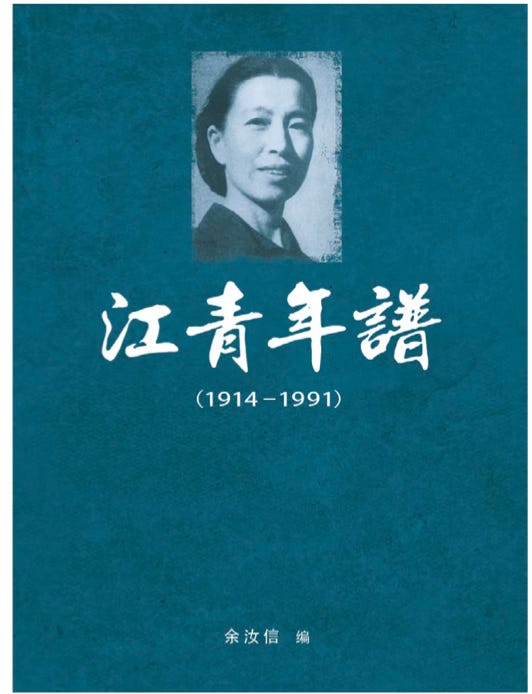
作为毛泽东的最后一位合法妻子、“文化大革命”的旗手、“批林批孔运动”的领导者,江青是文革研究绕不开的一个人物。
2026年5月,《江青年谱》一书由香港新世纪出版社(New Century Press)出版。在这本书中,多年来致力于文革历史研究的中国独立学者余汝信,详细梳理了江青的生平,如其所言,“考证、对勘和辨析相关史料”,对江青的人生以及和毛泽东、文化大革命的关系,提供了另一个研究的视角。
这本书也是新世纪出版社继《陈伯达年谱》、《康生年谱》两本书之后,出版的又一部年谱研究著作。也是该出版社为了纪念“文革六十周年”而出版的系列书籍之一。
1
新世纪出版社于2005年在香港成立,创始人是鲍朴——他的父亲鲍彤曾任前中共中央总书记赵紫阳的政治秘书。当时,纵使中国的出版审查制度还没有今天如此严厉,但与文革研究有关的书籍,一直很难在大陆出版,鲍朴带领新世纪出版社,在一度享有言论自由的香港,做了卓有成效的尝试。
2012年,哈佛大学教授、著名学者麦克法夸尔(中文名马若德)的著作《文化大革命的起源》,由新世纪出版社出版了三卷中文版。此书是中国之外研究文革的重要著作,对文革研究者、关心中国当代历史真相的中文读者来说,意义重大。
与此同时及其后,新世纪出版社又接连出版多部与文革有关的著作,包括被打成“林彪集团”的黄永胜、吴法宪、李作鹏、邱会作等关键人物的回忆录。这些回忆录,从亲历者的角度,为研究文革以及共产党历史提供了重要资料。
《江青年谱》一书的作者余汝信,出生于广东梅州,据他自述,青少年时期的他在广州亲身经历文革,由此埋下了未来研究文革的想法与兴趣,并一直留意资料的收集。本世纪初他脱离体制后,开始了独立研究。目前已出版的有文革有关的著作包括:《香港1967》,《红卫兵兴衰录》(编注)、《“九一三”回望》等。2016年,他的《风暴历程——文革中的中国人民解放军》一书由新世纪出版社出版。
2
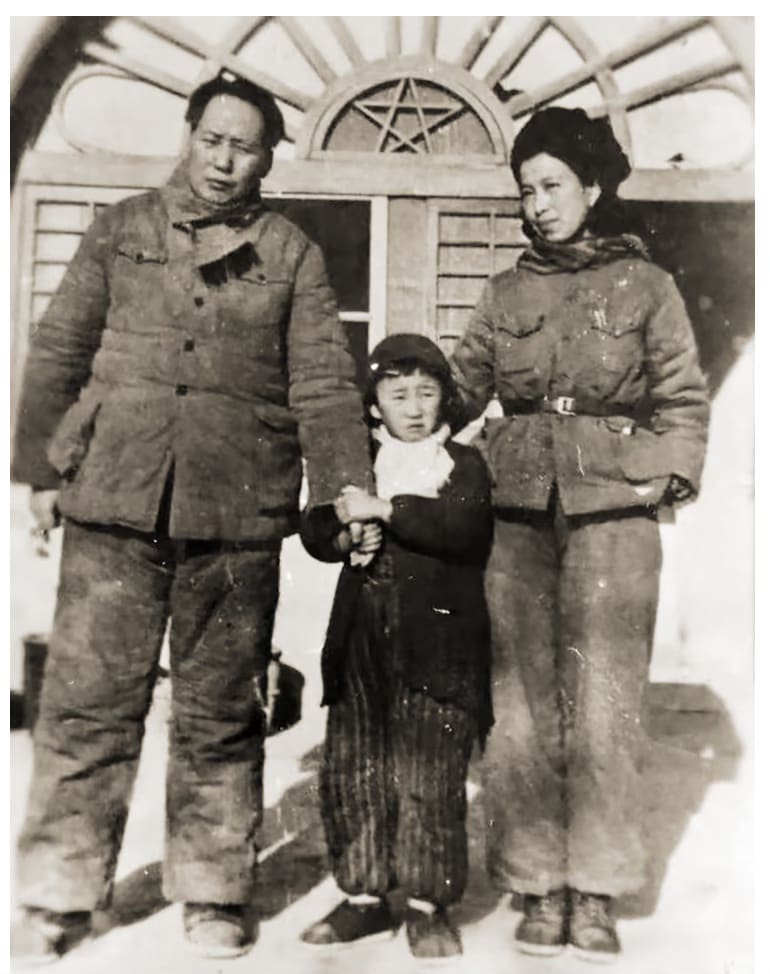
1938年,24岁的江青在延安与毛泽东结婚,从此命运与毛泽东绑在了一起。文革结束之后,江青更成了一个符号与象征的人物。1981年1月25日,江青被判处死缓,剥夺政治权利终身。1991年5月14日,她在秦城监狱中服安眠药自杀。
如鲍朴所言:江青成为“文革旗手”绝非偶然,当然离不开毛的授权。江青也确曾尽其所能,忠实执行文革精神。她所推动的几部样板戏,尤其是《红色娘子军》,一方面展示了“阶级斗争女权”及其造就的结果,更重要的是,展示了从苏联输入的极端意识形态与文艺形式,在中国文化环境中被推向极端后的状态。
作为文革的符号与象征人物,江青早年的经历如何?和所谓“四人帮”之一的康生是否在年轻时就相识?她在上海的婚姻状况如何?她和毛在结婚前是否有传言中的“约法三章”?谁参加了江青和毛泽东的婚礼?在中国,因为官方对文革历史一直讳莫若深,人们对真实的江青其实知之甚少,一些被民间窥探和长久以来流传的说法,并不符合事实。在作为《江青年谱》序言的《江青史料十辨》一文中,余汝信做了一些解答。
本书出版后,鲍朴于2026年5月发表《中国传统史观下的文革历史——江青年谱出版杂记》一文。该文中文版刊发于新世纪网站和波士顿书评上。读者可以通过链接查看。民间档案馆编发其英文版,以飨英文读者。
在这篇文章中,鲍朴回顾了人物年谱的价值。他写道:“人物年谱是中国传统史学中一种颇具特色的著述形式,其早期形态至少可追溯至北宋时期的《杜工部年谱》,即杜甫年谱。年谱将相关史料依时间先后逐条编排。”
鲍朴认为,文革研究至今,分为三部分,包括官方叙事(以十一届六中全会《关于建国以来党的若干历史问题的决议》为代表),其二是民间社会研究,其三是海外华人与西方学术研究。前者与后两者,往往发生冲突。
鲍朴在这篇文章中也写道:
1980年,在审判庭上,江青自辩道:“你们逮捕审判我,这是丑化毛泽东主席。审判我就是丑化亿万人民,丑化亿万人民参加的无产阶级文化大革命。”殊不知,当年追随其后、投入文革的所谓“亿万人民”,在毛死之后竟会顷刻间消失得无影无踪……
正如资深记者高瑜评论鲍朴的文章时所说:文革结束后,江青作为“反革命集团成员”,和“林彪反革命集团”一起,承担了本来应该由具有无上权力的毛泽东承担的文革罪责。而“这是中共执政77年的历史中说不通,也不符合历史真实的荒唐之处。”
对鲍朴来说,今年是文革爆发六十周年,适逢《江青年谱》出版,而他的这篇出版杂记,也正如“再思历史的一篇祭文”一般。而余汝信所撰的这本《江青年谱》也正可视为文革研究中一种另辟蹊径的探索。
Editors’ Note:
Jiang Qing Chronology is a new book by Hong Kong’s New Century Press. Jiang Qing, as Mao Zedong’s wife and one of the most prominent proponents of the Cultural Revolution, is a critical figure in the history of the People’s Republic of China. Bao Pu, the head of New Century Press, penned the following notes on the publication of Jiang Qing Chronology. The original Chinese version has appeared on multiple Chinese-language websites. The China Unofficial Archives is publishing the English version, provided by Mr. Bao Pu, for the first time.
The Cultural Revolution from the View of Traditional Chinese Historiography
—Notes on the Publication of Jiang Qing Chronology
By Bao Pu
The publication of Jiang Qing Chronology coincides with the 60th anniversary of the Cultural Revolution that was launched in mainland China in 1966. Consider this a eulogy, and a reflection on history. Since its founding, New Century Press of Hong Kong has published several works on the Cultural Revolution. In our most recent years, we have focused on publishing biographical chronicles such as Kang Sheng Chronology and Chen Boda Chronology. Jiang Qing Chronology is the final work in this series.
What is a Chinese “Chronology” (年譜)?
Chinese biographical chronicles or chronologies are a distinctive form of writing in traditional Chinese historiography, with their early forms traceable at least to the “Biographical Chronicle of Du Fu” (《杜工部年谱》), written during the Northern Song Dynasty. Unlike contemporary historical narratives, which prioritize ease of reading, biographical chronicles arrange relevant historical materials chronologically. However, they are not merely compilations of historical data, nor are they simply “spreadsheets”.
Like other traditional historical genres, biographical chronicles involve both deconstruction and construction, reflecting the historian’s selection, judgment, and organization of materials, representing a unique perspective. The Biographical Chronicle of Liu Xiang and Liu Xin (《刘向父子歸年谱》), published in 1930, is a significant 20th-century example. The author, Qian Mu, wrote this book directly to address the famous reformer Kang Youwei’s 1900 Study of the Forged Classics of the New Learning (《新学作伪经考》), reflecting a specific historical context. In his book, Kang Youwei alleged that Liu Xin of the Western Han Dynasty forged ancient books to assist Wang Mang in compiling the Outline of National Reconstruction for his usurpation of the throne. This claim, presenting ancient books as “material evidence” and identifying an imperial “motive” seemed to be the solving of a cold case. Its impact at the time was significant. Kang’s claim cast suspicion on all the ancient classics. Classics of Poetry《詩經》, Zuo Zhuan《左傳》, and The Rites of Zhou 《周禮》 should be considered “forgeries”. Even the Records of the Grand Historian《史記》 and The Songs of Chu《楚辭》should be suspected of having been “altered”.
However, Qian Mu, then a school teacher, traced the evolution of various schools of classical studies over the approximately 120 years from the Western to the Eastern Han Dynasty, to prove that Kang’s claim was fundamentally untenable. Qian Mu’s work can be seen as a saviour of classical studies at a time of an existential threat, and Qian Mu himself a pillar of traditional Chinese historiography against the tide of the times.
The Incomprehensibility of Cultural Revolution History
Yu Ruxin, author of the series “Biographical Chronologies of the Cultural Revolution,” hails from Meixian, Guangdong, and comes from an overseas Chinese family. His father returned to China during World War Two to study and participated in the resistance against Japanese invasions in northern Vietnam. He devoted his life to the study of pre-Qin history and taught related subjects at universities. During the Cultural Revolution, Yu remembers his father comparing articles written on the same topic by different authors to tease out the truth. This method of historical research left a deep impression on the young Yu Ruxin, and eventually formed the basic principles of his research on the history of the Cultural Revolution.
The existing research on the history of the Cultural Revolution can be broadly divided into three main lines: the official narrative, also known as “official history”; the memoirs of ordinary people; and the analyses of overseas Chinese and Western academics.
The official narrative was largely set by 1981, defining the Cultural Revolution as “an internal turmoil wrongly initiated by leaders, exploited by counter-revolutionary groups, and bringing serious disasters to the Party, the country, and all ethnic groups.” At the time, Deng Xiaoping instructed that research on the Cultural Revolution should be “broad rather than detailed.” However, “the devil is in the details” (a German idiom), or “God is in the details” (Flaubert’s Madame Bovary); that is, without details, there is no way to judge the ultimate nature. As a result of this policy, the details provided by social memory and overseas scholarship could not align with the official characterization. Instead, they gradually diverged, forming differing frameworks of understanding, such as traumatic memory, nostalgic narratives, reflective narratives, and academic reinterpretations. Yu Ruxin’s biographical chronology is an exploration and attempt at a different approach.
The current division between theory and practice in the study of Cultural Revolution history is temporarily irreversible. This is because official history, personal memories, and overseas and Western scholarship each has its own inconsistencies in historical understanding. By “consistency”, I refer to the “understanding of the changes of ancient and modern times” as described by grand historian Sima Qian, meaning that there must be a reasonable explanation for events preceding and following them.
First, let’s discuss official history. Jin Chongji, an expert on the history of the CCP and modern China, once said, “Most people think the ten years of the Cultural Revolution are difficult to write about, but actually, the most difficult to write about are the ten years before that.” This statement reveals at least two things. First, it indicates that the origins of the Cultural Revolution should be traced back to a series of historical events in the ten years prior, from 1956 to 1966. Second, regarding why the Cultural Revolution occurred, it is still difficult to offer a sufficiently clear and coherent explanation. The official characterization of the Cultural Revolution is: “ten years of internal turmoil.” However, if, excluding direct external intervention, even official historians struggle to explain the causes of such a major “internal turmoil,” then the fundamental nature of this nationwide political movement is naturally difficult to define. This will inevitably lead to a series of intractable problems.
Next, let’s revisit the social memory of the people. In the early 1980s, many victims of the Cultural Revolution were gradually rehabilitated. Simultaneously, social memories of the Cultural Revolution were released, primarily in the forms of “scar literature” and “youth education literature.” Subsequently, memoirs of former high-ranking Party and military figures who had been victimized during the Cultural Revolution were published, such as those of Huang Yongsheng, Wu Faxian, Li Zuopeng, and Qiu Huizuo, the top generals of the so-called “Lin Biao Group.” Yu Ruxin, author of the “Biographical Chronologies of the Cultural Revolution Series,” participated in the publication of Qiu Huizuo’s memoirs as an “editor by special invitation,” thus establishing his first connection with our publishing house.
Several fundamental questions of right and wrong in the Cultural Revolution remain unanswered to this day. For example, how could these people, who devoted their lives to the Party with absolute loyalty, be labelled an “anti-Party group” overnight? After the 2000s, with the advent of the internet age, discussions in this field of memory expanded significantly. However, its expansion has always sought to limit itself to the confines of existing official characterizations. The initial mainstream of grassroots social memory primarily consisted of narratives of grievances from the victims and their families. However, as the saying goes, “every wrong has its perpetrator, every debt its debtor.” The most difficult to reconcile in such narratives is the fact that while the victims are made visible, the perpetrators are often difficult to identify. More importantly, the victims spanned a wide range of social groups, from the highest levels of the Party and the State to ordinary citizens, and this complexity made the motive and “intent to harm” increasingly elusive.
Subsequently, social memory further diverged, presenting a situation of multiple conflicting voices. Victims’ families demanded deeper accountability, while liberal intellectuals attempted to push for a more thorough political reflection; a very small number of former Red Guards and eyewitnesses attempted to publicly “apologize,” but because no one was willing to accept the ethical responsibility associated with such apologies, it only reignited controversy. Meanwhile, some “Neo-Leftists” harbor nostalgia for the egalitarian demands, anti-bureaucratic passion, and mass political participation of the Cultural Revolution, and attempt to downplay the violence, some even hoping for an overturning of the official characterization.
As for research by overseas Chinese and Western academia, a definitive conclusion on the fundamental nature of the Cultural Revolution has yet to be reached. In 2012, our publishing house published a complete Chinese translation of Roderick MacFarquhar’s three-volume The Origins of the Cultural Revolution. This work provides a meticulous and thorough analysis of the causes and consequences of the Cultural Revolution, tracing its political roots back to 1956. This chronological assessment corroborates the assertion by official historian Jin Chongji that the decade before the Cultural Revolution was “even more difficult to write.” One of the book’s significant contributions lies in the author’s assertion that throughout the Cultural Revolution, while none of the CCP’s top leaders—from Peng Dehuai, Liu Shaoqi, and Lin Biao to Deng Xiaoping and Zhou Enlai—willingly participated in the Cultural Revolution, none openly showed disloyalty to Mao Zedong. On the contrary, each did his utmost to faithfully carry out Mao’s will. Nonetheless, all these henchmen of Mao were to suffer tragic fates, to varying degrees. Of course, there are differing opinions in overseas academia regarding MacFarquhar’s work, such as the criticism that the author overemphasizes the impact of high-level relationships over institutional factors.
In a broader academic context, the center of Western Sinology had shifted from Europe to the United States earlier in the 20th century. During the process of social science development, this gradually led to the formation of the Harvard school, represented by John King Fairbank, and other research directions. A fundamental viewpoint of this academic approach is that a comprehensive understanding of modern China cannot be achieved solely through existing Western ideologies and terminology. MacFarquhar was a key figure in the Harvard school. In the epigraph of his book The Origins of the Cultural Revolution, he quotes from the Ming Dynasty novel Water Margins by Song Jiang (aka. All Men Are Brothers in Pearl Buck’s English translation): “Our names are writ upon the Heavens, nor may the men of Earth despise us. In this day we unite our purpose, and until we die we will not be divided in it…” Yet, the tension is contained in the following ominous warning to those who “begin well” but “ends ill”: “let the Spirit of Heaven search among us and the Demons of the Earth encompass us, for surely this one will die by sword or arrow or thunder will fall upon him to destroy him. Then let him lie forever in Hell, that in ten thousand cycles of life he may not come to life again.”
As for other overseas and Western scholarship, it largely follows the development of “modernization theory” and the subsequent rise of “postmodernism.” The former often presupposes a certain “universality” of Western culture, while placing Chinese culture in a position of “particularity”; the latter can be seen as a reflection on and deconstruction of various previous “orthodox ideologies.” In the field of China studies, Jonathan D. Spence is a representative figure. His writings combine the remnants of Hegelian historical philosophy with the tradition of empiricism, skilfully using historical materials and details to tell highly readable narratives about China. Hsu Cho-yun’s bragged about Spence to promote his book: “Give him a phone book, and he can write up stories from the first page of names to the last person.” This is certainly high praise of his narrative talent, but also makes one wonder: is such a narrative history or fiction?
While Spence has no specific works on the Cultural Revolution, he has a fairly clear assessment of Mao Zedong, the initiator of the Cultural Revolution, namely, his “monstrous and ridiculous” nature. In his view, Mao was just one among a string of rulers, “in China’s long tradition of formidable rulers who wielded extraordinary powers neither wisely nor well,” ruling only by the “force of their own character”. This judgment is satisfying to the anti-tradition modern reader, including many Chinese, but it fails to explain how Mao Zedong was able to change China faster and more powerfully than any ruler in history, his influence even surpassing that of the First Emperor, Qin Shi Huang. Jonathan Spence’s assessment is perhaps limited by his following of Hegel’s assertion that Chinese history was shaped by the emperor acting as a “high magician”. In Hegel’s assessment, China does not truly have any history, at least not the kind of real human history he defines as driven by the Zeitgeist.
To return to the main point, let’s go back to the Cultural Revolution. According to the official narrative, the Cultural Revolution was undoubtedly a failure, hence the later need to “correct past mistakes.” The problem lies here: Mao Zedong ruled for only 27 years, yet he spent ten of those years paving the way for the “unprecedented internal turmoil” of the next ten years. Doesn’t this confirm Jonathan Spence’s view of a horrific absurdity? Within the historical context of the People’s Republic of China, which is less than eighty years old, both the Cultural Revolution and Mao Zedong are still difficult to define; how should they be judged as seen in their place within the millennia of Chinese history?
These unresolved historical questions are the starting point for the exploration of the “Biographical Chronologies of Cultural Revolution Series.”
Firstly, it can be seen that in writing the chronological series, official history, grassroots social memory, and overseas and Western academic research are all indispensable. While official history certainly has many gaps, its information remains essential. Jin Chongji said, “Criticize Lin Biao and Confucius: why connect Lin Biao and Confucius? When we were writing about how Chairman Mao criticized Confucius, (Hu) Qiaomu asked us to understand that the Chairman fell into a contradiction in the process of exploring and moving forward, especially in his later years.” However, official historians have provided no further explanation as to what contradiction Mao fell into.
Chinese historiography has a tradition of “profound meaning in concise words.” Even the smallest remarks of official historians can possess profound historical implications. The so-called “Cultural Revolution,” in its name and its intention, was indeed a revolution against the very essence of Chinese cultural tradition. This accounts for the “coherence” and the “incompatibility” of the Cultural Revolution, Mao Zedong, and even the history of the People’s Republic of China within the grand narrative of Chinese history, which is ultimately related to Confucius. A breakthrough is urgently needed on this important issue for our understanding of the progression of Chinese civilization.
Secondly, in the preface to Jiang Qing Chronology, author Yu Ruxin uses concrete examples to illustrate that “all historical materials included in this chronology have been repeatedly verified, compared, and analyzed by the editor using common sense and logical reasoning.” This statement is based on specific reasons. As the first work in the “Chronology Series of Cultural Revolution Figures,” Kang Sheng Chronology: The Life of a Chinese Communist was published in 2023. Upon its release, some argued that the book was an attempt to “rehabilitate” Kang Sheng. The so-called “reversal of verdict” refers to the accusation that the chronology “deliberately” avoids mentioning Kang Sheng as “evil”. The criticism was that Kang Sheng was closely involved in numerous wrongful convictions and miscarriages of justice during the Cultural Revolution; therefore, from the perspective of the victims and their families, and indeed all those who resent the consequences of the Cultural Revolution, such a portrayal is clearly unacceptable.
Subsequently, “Another Edition” of Kang Sheng’s chronology was published in response by a critic who proclaimed Kang Sheng as “both a treacherous and vicious villain and a highly talented scholar well-versed in traditional Chinese culture,” which is “the basic assessment of Kang by Chinese academia.” It also fully affirms the official conclusions of the Central Commission for Discipline Inspection’s “Report on the Investigation of Kang Sheng,” describing Kang Sheng, in the author’s words, as “a truly wicked person who harmed countless people and committed numerous murders.” This effort by Kang Sheng Chronology: Another Edition is actually rather revealing: its intention is to suppress any attempt to exonerate Kang Sheng, the accepted “bad guy”, to “reverse” the “reversal of the verdict.” In other words, it returns to the official historical characterization of Kang Sheng (blamed post-mortem for the Cultural Revolution) and also stays within the limits by officialdom to shift all blame to those labelled as the “counter-revolutionary group.” This inevitably calls to mind the saying: “daring only to attack the dead tiger.” If Jiang Qing Chronology were to elicit a response similar to Kang Sheng Chronicle: Another Edition, the outcome is predictable.
This leads to a more historically interesting question: terms used in China such as “struggling against”, “friends versus foes”, or “good versus evil” — born out of class-struggle dialectical materialism, full of absolutist judgments, all products of the Cultural Revolution. Now deeply ingrained in the minds of modern Chinese people, they run counter to the “middle way” valued in traditional Chinese culture. Another Edition falls into the logic of the Cultural Revolution. The “modern way of thinking” of its authors is widespread and prevalent today, shared among even those who see each other as political opposites. Given this, should the Cultural Revolution be considered a success for Mao Zedong, both self-proclaimed and acknowledged as its initiator? To some extent, this scenario demonstrates the continued consequences of the disconnect between official narratives and historical accounts.
Why do official histories, grassroots social memories, and overseas and Western scholarship all present inconsistencies regarding the Cultural Revolution? What is the crux of the problem? The answer lies in the historical narrative style familiar and admired by contemporary Chinese people, which can only record the “changes” in history, essentially losing the ability to identify the “constants” of traditional Chinese history. Western social science-based historiography lacks this tradition of distinguishing between “constants” and “changes.” But this is beyond the scope of this article.
There is a Chinese proverb describing towns on the banks of an ever-shifting Yellow River: “Thirty years east of the river, thirty years west of the river.” Sixty years after the Cultural Revolution, is China on the east or west side of the river? Faced with this question, contemporary Chinese people find that they don’t actually understand the history of the Cultural Revolution very well. All they can be certain of is that the times have indeed changed. Therefore, their understanding of the Cultural Revolution likely remains in a state of “ten people, ten interpretations; a hundred people, a hundred interpretations”.
Perhaps we could take Jiang Qing Chronology on an exploratory trip, by examining it in the spirit of the ancients.
First, both Mao Zedong and Jiang Qing are deceased. According to Chinese tradition, once gone, they do not transform into “Satan”, nor can they continue to be treated as “human.” The First Emperor of China, Mao Zedong, and Jiang Qing are all, in essence, simply “ancestors.” And towards ancestors, Chinese tradition advocates the attitude of jing (敬, respect/honor), considered a primary virtue. (At this point, many Chinese will be cursing me, but that’s alright). Let’s first examine the meaning of jing in the spiritual world of the ancients. jing does not in any way mean what is now meant by the term “worship”. Instead, jing is a cultivated personal virtue, manifested in inner focus, caution, and clarity. It can be said that jing is a concentrated expression of the fundamental seriousness and responsibility the ancient Chinese felt towards the world, and the starting point for all cognition and understanding. Cursing can satisfyingly vent emotions, but cultivating jing allows one to begin to comprehend the world and one’s place in it.
Early Practices of Feminism
Jiang Qing, originally named Li Yunhe, was born in 1914. Just three years before her birth, the end of the imperial system in 1911 had already altered the course of Chinese history. Her life’s starting point naturally fell within the torrent of the modern revolution, making her one of the earlier generations of “modern Chinese” who had effectively severed ties with traditional Chinese culture.
The May Fourth Movement erupted in 1919, with women’s liberation one of its core issues. Like many intellectual women of her time, Li Yunhe’s early pursuits were naturally women’s liberation and gender equality. However, due to her unique circumstances, the path she took was exceptionally tortuous.
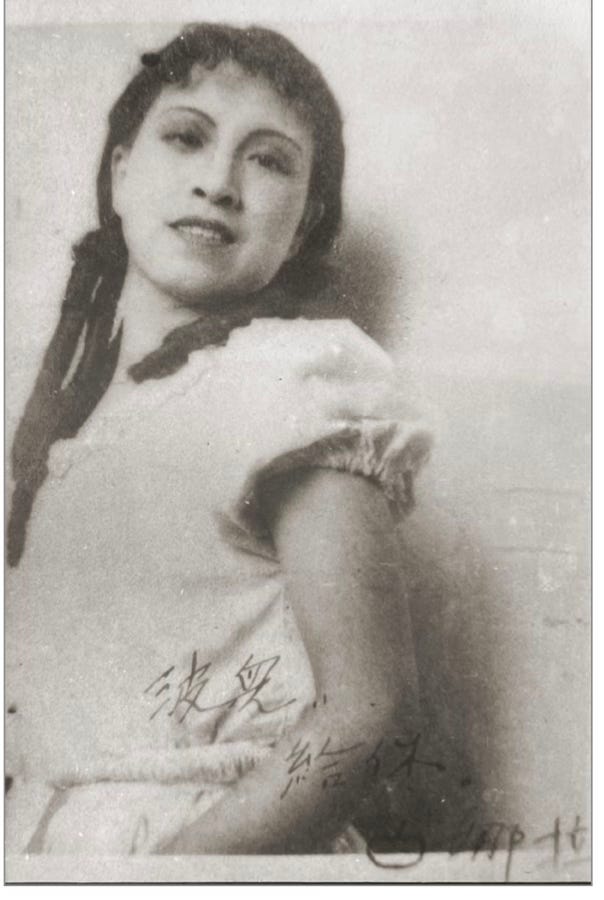
During her performing career in Shanghai, Li Yunhe used the stage name “Lan Ping” and was chosen to play Nora in Henrik Ibsen’s A Doll’s House. Nora appears as an innocent and cheerful wife, but in her husband’s eyes, she is not an equal, but rather an appendage with decorative and malleable value. In the end, Nora leaves her husband and even her own children, an act that shocked many audiences in Europe at the time. The play not only pioneered a critique of the marriage system and gender roles in European society at the time, becoming a significant milestone in women’s liberation, but was also a forerunner of realist drama. Both of these aspects had a profound impact on Li Yunhe’s life.
A Doll’s House premiered in Europe in 1879 and debuted in Shanghai in 1935, a span of 56 years. Half a century may seem a long time, but placed within the context of the thousands of years of change in gender relations and institutions in Europe and China, until then mostly developed separately, these 56 years are strikingly short. During Lan Ping’s active period in Shanghai, the character of Nora was no longer merely a foreign figure on a stage; it acquired a tangible significance in Li Yunhe’s real life.
Behind this, however, was more than just one dramatic personal experience, but the rapid transformation of China’s urban elite culture. This change was not a natural evolution of China’s own gender order, but rather the transplantation of an entire set of women’s liberation issues grafted from Western historical experience onto Chinese society within a very short period. This issue touches upon not only the personal fates of Lan Ping or Li Yunhe, but also on how the entire modern Chinese spiritual world is being restructured and rewritten, which goes far beyond the scope of this article.
Lan Ping was a stage figure of women’s liberation, while Li Yunhe was a practitioner of women’s liberation in real life. Faced with hostile rumors in the newspapers, she stated, “I am absolutely not like Ruan Lingyu, who committed suicide or retreated because of ’the fear of gossip’,” thus demonstrating her distinctively strong will. Furthermore, as she said, “I began to love other people. Under these circumstances (the breakup with Tang Na), what does it have to do with him that I loved someone else?” (Chronology, 1-2 June 1937). This further shows that while pursuing women’s liberation, she had a clear understanding of what kind of man she wanted, or more accurately, what kind of man she didn’t want. The gossip was about nothing more than a few romantic relationships. In 1930s China, it was not uncommon for men to have multiple wives and concubines; therefore, even if her rumored lovers were ten or a hundred times more numerous, from the perspective of “gender equality,” it was not entirely unreasonable.
Li Yunhe’s understanding of women’s liberation clearly goes beyond simply leaving the traditional family. “If Nora leaves the family, will she no longer be manipulated? Could she become a real person?” she asks in her “Actor’s Monologue” (Chronology, 27 June 1935). From her conversations with American historian Roxane Witke, it’s clear that her true ideal of womanhood was the figure in the 1933 Hollywood film “Queen Christina”. Historically, Queen Christina of Sweden ascended the throne at the age of six in 1632 and reigned for twenty-two years. She was a lifelong reader, educated like a man per her father’s instructions, and deeply interested in religion, philosophy, and the arts, attempting to build Stockholm into a “Northern Athens.” However, even more symbolic than these achievements was her rejection of traditional female roles: she often dressed as a man, and refused arranged political marriages, thus shocking her countrymen and all of Europe. The film concocts a secret affair as the reason for her abdication of the throne, choosing instead to live free with a man beneath her station. If Nora represented a departure from the traditional family order, then Christina symbolized a rebellion against the entire gendered social order. Li Yunhe’s aspirations are perhaps closer to the latter.
It is precisely under this spiritual orientation that Li Yunhe’s life path could not remain confined to the urban cultural sphere, but inevitably shifted towards a broader and more intense political arena. Before the Xi’an Incident in 1936, ordinary Chinese people saw the CCP, at best, as a bunch of heroic outlaws, gathered in rebellion. After the Xi’an Incident, its political status underwent a fundamental change; they were seen as entering the halls of power and recognized as part of China’s orthodox and legitimate structure. The large-scale migration of left-wing intellectuals to Yan’an began under these historical conditions, and Li Yunhe was among them.
Jiang Qing’s Relationship with Mao Zedong
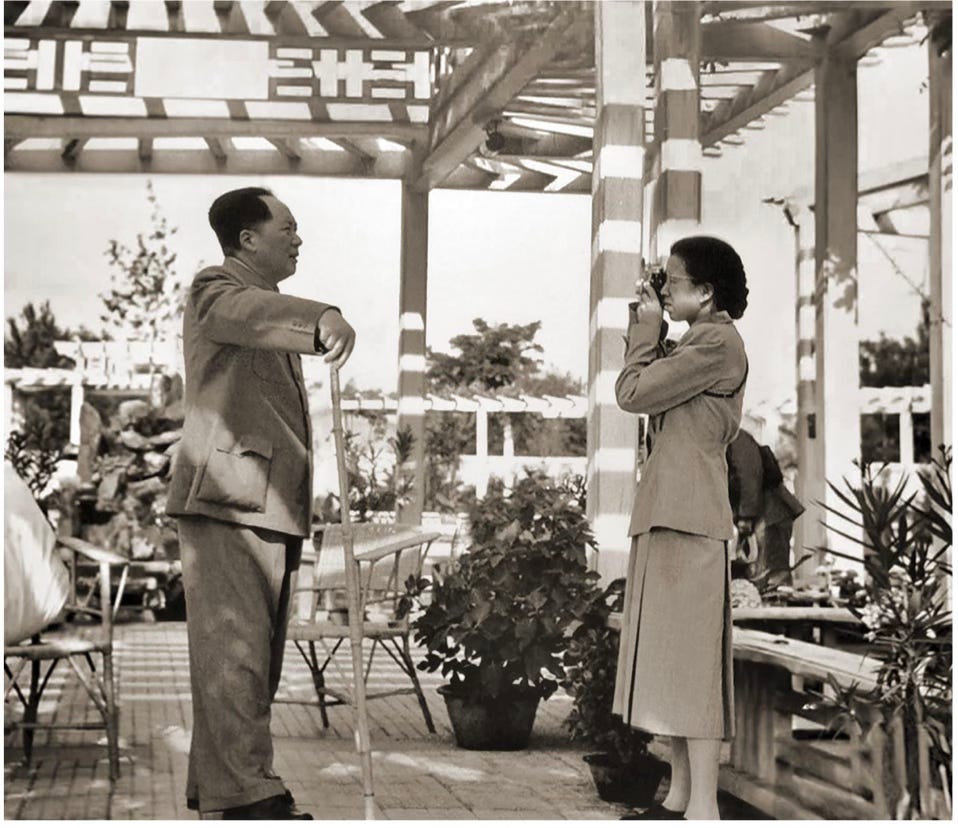
In the summer of 1937, Li Yunhe arrived in Yan’an. During her time in Yan’an, she changed her name from “Lan Ping” (blue apple) to “Jiang Qing,” (river qing, a light green-blue associated with the finest jade, or the sky) implying that she had surpassed her former self, marking a new and higher stage in her life. The following year, at the age of 24, Jiang Qing married Mao Zedong. It should be noted that at that time, Mao Zedong was still 11 years away from finally seizing power, and in the historical context of 1938, almost no one could have foreseen his future rise to power. Jiang Qing chose Mao Zedong the man, rather than for his nascent power. When rumors of Lan Ping’s affairs in Shanghai were reported to Mao by those within the Party who opposed their marriage, he “became furious and tore up the letter on the spot” (Chronology, November 1938). Mao’s character is self-evident.
The relationship between Jiang Qing and Mao Zedong is extremely difficult to summarize simply. Given Mao Zedong’s absolute power, he was undoubtedly in a dominant position in their relationship and could not have been “used” by Jiang Qing. To the historian Roxane Witke, Jiang Qing openly reveals her admiration for Mao: “I worshipped him.” Before 1949, Jiang Qing was undoubtedly Mao’s soulmate. However, in 1966, with the issuance of the “May 16th Circular” and the official launch of the Cultural Revolution, when even Mao Zedong had to pause to consider the moment, he wrote a candid heartfelt letter to Jiang Qing. It was a rare occurrence and the letter is considered one of the most important historical documents for understanding Mao Zedong’s inner world (Chronology, 8 July 1966).
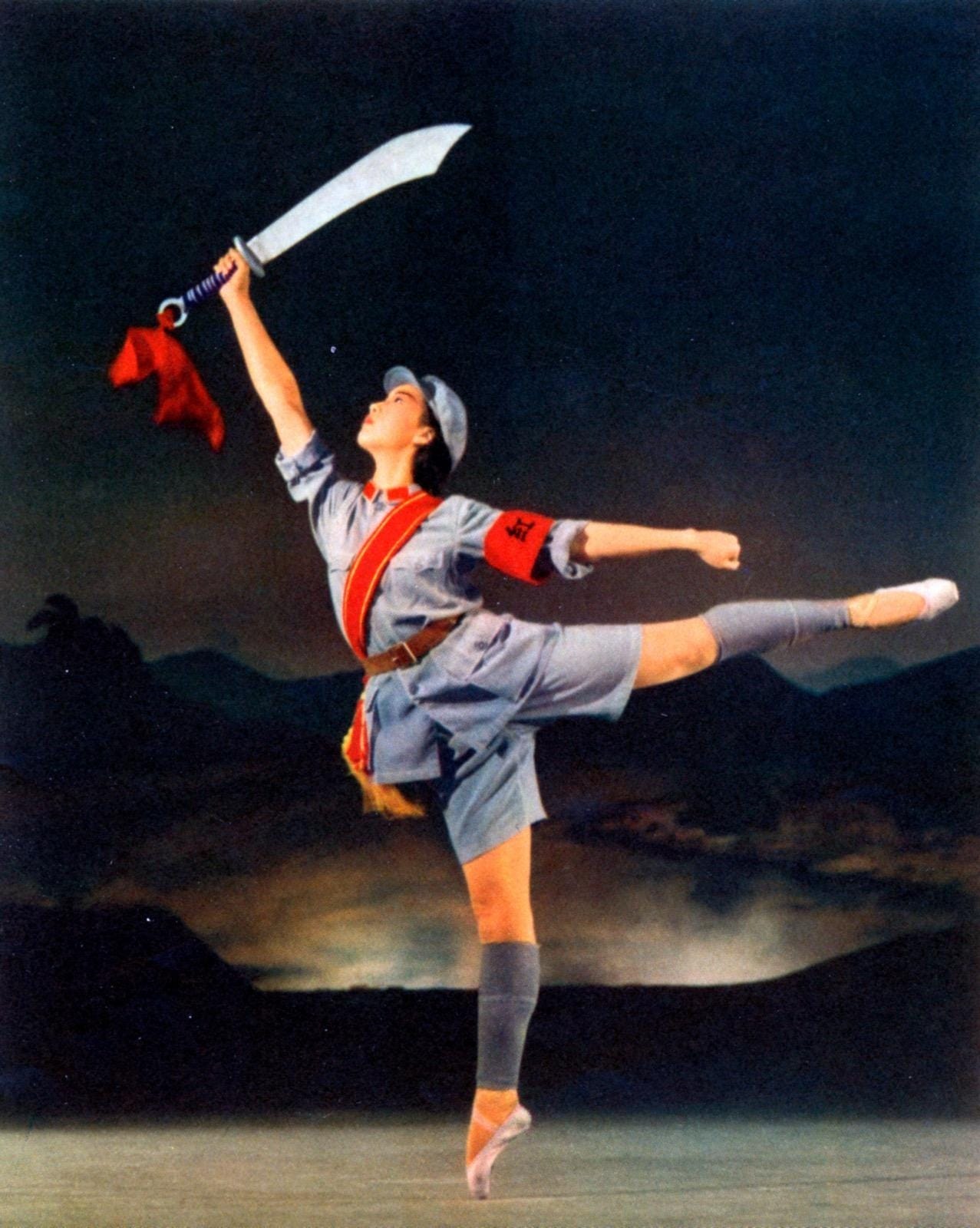
Jiang Qing may not have been politically astute, but she certainly understood theatre, and Mao Zedong knew this. Literature and performing arts were the most concrete and actionable aspects of the Cultural Revolution, so Jiang Qing’s rise to “standard-bearer” of the Cultural Revolution was no accident. Her rise was by Mao’s authorization, and she faithfully implemented the spirit of the Cultural Revolution to the best of her ability. The “model operas” she promoted, especially “The Red Detachment of Women”, showcased the final de-gendering of class-struggle feminism. Furthermore, they manifested Western ideologies and artistic forms imported from the Soviet Union and pushed them to an extreme within a Chinese cultural environment. There has never been anything like it, before or since.
In July 1973, Mao Zedong, in conversations with Zhang Chunqiao, Wang Hongwen, and others, further distanced himself from Zhou Enlai (Chronology, 4 July 1973). Zhou was perhaps the last remaining confidante among his former “brothers,” all the others having fallen foul of Mao before him, one by one. In August of the same year, Mao launched his last political movement, the “Criticize Confucius” campaign. By then, the isolated Mao had only Jiang Qing left to rely on, and she remained relentlessly zealous. (Chronology, 5 August 1973) It seems plausible that if Mao were asked who was closest to him and who he most trusted throughout his life, he would choose Jiang Qing. Therefore, the official narrative attributing the main responsibility for the Cultural Revolution’s internal turmoil to the so-called “Jiang Qing counter-revolutionary clique” is historically illogical. If Jiang Qing was “anti-Party,” it would be more accurate to say that Mao Zedong was “anti-Party”. In the actual initiation and operation of the Cultural Revolution, the two were inseparable, two sides of the same coin.
If we acknowledge that the Cultural Revolution was a dramatic upheaval in Chinese history, then the historically significant question is: what “changed” and what remained “unchanged”? The Cultural Revolution is described as “unprecedented”; if we consider its most shocking aspect, what truly makes it “unprecedented” lies in the unprecedented extremes of Chinese criticism and negation of Confucius during this period. Reaching any historical “ultimate” point is never easy; and the answer to how the Cultural Revolution achieved this can actually be partly found in the life experiences of Jiang Qing.
Jiang Qing was born in 1914, and Mao Zedong was born in 1893, a difference of 21 years. But these 21 years were more like a lifetime than a generation, for during that time, China experienced the First Sino-Japanese War of 1895, the abolition of the imperial examination system in 1905, and the revolution of 1911 that ended thousands of years of imperial rule and gave birth to the Republic of China.
Jiang Qing’s earliest spiritual leader was the author Lu Xun, and the founding ideas of her life grew out of the anti-traditional, anti-Confucius May Fourth Movement of 1919. Born 21 years earlier, Mao Zedong was educated in the traditional culture, and clearly revered Confucius during his youth and even in his prime. His four-character poem “Sacrifice at the Mausoleum of the Yellow Emperor,” written in 1937, is evidence of this. Phrases such as “illustrious ancestor, founder of our Chinese civilization,” “establishing this great undertaking, standing tall in the East” and “truly witnessing Heaven and Earth,” all demonstrate that his spiritual world had not deviated from traditional Chinese culture.
Why Mao Zedong increasingly turned against Confucius in his later years is a complex historical trail that takes us far beyond the scope of this article. In Chinese history, anti-Confucianism is not uncommon, starting in Confucius’ own day. But none wielding great power could push it to such an extreme. The overwhelming momentum of the anti-Confucian movement during the Cultural Revolution was undoubtedly due to Mao Zedong’s unprecedented personal power with the unwavering commitment of Jiang Qing as the “standard-bearer.” The combination of these two factors resulted in a force so great that it forced Feng Youlan, the most revered living Confucian scholar, into becoming an advisor to the “Liang Xiao” group (a “mass criticism group” at Peking and Tsinghua Universities). In the “Liang Xiao” reports, Confucius was denounced as “a restorationist fanatic turning back the clock of history; a hypocritical and cunning political swindler; a vicious and brutal tyrant; an ignorant parasite; and a stray dog constantly running into obstacles.” Such anti-Confucian rhetoric and the momentum it generated was truly unprecedented in the millenia of Chinese civilization.
Lu Xun was Jiang Qing’s first spiritual mentor
“A three-foot layer of ice is not formed in a single day.” As mentioned earlier, while MacFarquhar successfully traced the political origins of the Cultural Revolution to 1956, he ultimately failed to place it within the broader context of Chinese history by further exploring its ideological origins. In fact, anti-Confucianism had extremely deep ideological roots in the 20th century, and many of its concepts are now common knowledge among Chinese people in the 21st century. However, this is another vast issue, so we will only briefly mention one aspect to illustrate its point.
Professor Qin Hui, the author of the preface to Jiang Qing Chronology, points out that attributing Mao Zedong’s historical problems to Jiang Qing, using the so-called “female calamity” argument, is utterly absurd. On the other hand, he also believes that Jiang Qing’s feminism, as represented by “The Red Detachment of Women”, was unsuccessful.
This so-called “female calamity theory” attributes political failures to women. It was Lu Xun, Jiang Qing’s spiritual mentor, who is responsible for misleading contemporary Chinese intellectuals to believe that this attitude originates from traditional Chinese historical narratives. The most frequently cited example is the story of “the illustrious Zhou dynasty, destroyed by Bao Si”. The legend has the King of Zhou putting out a warning of an enemy attack at the Great Wall, triggering a surge by the military guards, but there is no attack, just a joke meant to bring a smile to the face of his beautiful concubine Bao Si; it is seen as the beginning of the end of the King’s legitimacy leading to the fall of the Zhou Dynasty. Even the Chinese saying “beautiful woman leads to disaster” has subtly changed its meaning over time: originally, “beautiful woman” simply referred to Bao Si, and “disaster” referred to dragon saliva. In later interpretations, it has gradually been interpreted as “beautiful woman” is synonymous with “disaster.”
There is a parallel that can be found in the story of Adam and Eve in the bible. In the story of Genesis, Eve was tempted by the serpent to eat the forbidden fruit, thus triggering the so-called “original sin”; she took a bite of the apple first, then shared it with Adam, ultimately leading to their expulsion from the Garden of Eden. Western traditional interpretations often understand this as female weakness and rebellion. However, the crux of the problem lies precisely here: in the idea of “temptation.”
It is here that Lu Xun infused the late 19th-century Western interpretation of Genesis into Chinese history, creating a new spin on Chinese legends. In February 1936, in his essay “A Jin,” he rejects the depictions of the most famous women of Chinese legend: “I have never believed that Wang Zhaojun’s departure to the border would bring peace to the Han Dynasty, or that Mulan’s joining the army would protect the Sui Dynasty; nor do I believe the old tales of Daji destroying the Yin Dynasty, Xi Shi ruining the Wu Dynasty, or Yang Guifei causing chaos in the Tang Dynasty. I believe that in a patriarchal society, women could never possess such great power, and the responsibility for rise and fall should be borne by men. But male authors throughout history have generally placed the blame for defeat and ruin on women; these were truly worthless and spineless men.”
However, a careful reading of traditional Chinese historical records reveals that the attributions of responsibility are actually quite clear: it is the men who are the subject of temptation; it is the men who make the decisions and suffer loss of reason, and ultimately, it is the men who lose power. In other words, the true bearer of historical responsibility was the monarch, not the woman. Attributing the downfall of a nation to Bao Si is absurd, yet this was how Lu Xun interpreted the legends. Following this logic, it seems that God should have cast out of Paradise the apple and the serpent, rather than Adam and Eve. The problem lies precisely in the fact that while such arguments satisfied the edgy contemporary postures critical of the past, it also misled and oversimplified the deeper lessons of historical responsibility, temptation, and decision-making.
In Lu Xun’s view, in all the pages of Chinese history, there is nothing but “cannibalism” and the so-called “female calamity” is merely another excuse for men to shirk responsibility in the face of historical defeat. Ironically, it was precisely Jiang Qing, the “standard-bearer of the Cultural Revolution,” who spearheaded the “Criticize Lin Biao and Confucius” campaign, that reintroduced the term “cannibalism” into the mouths of the proletariat, transforming it into an accusation against Confucius: “Confucius’s ’benevolence’ was ’cannibalism’.”
Confucius was not Aunt Zhao
During the “Criticize Lin Biao and Confucius” campaign, the deep-seated and radical anti-traditional thought accumulated since the 20th century erupted in a concentrated burst; the resulting nationwide participation echoed the proverb “ the wall falls when everyone pushes together”. In Dream of the Red Chamber, Ping’er defends Aunt Zhao: “Good ladies, ’the wall falls when everyone pushes together’! Aunt Zhao is confused and acting irrationally, but it’s because she is always blamed for anything that goes wrong.” During the Cultural Revolution, almost everything in Confucian tradition appeared to be swept away; the “wall” of Chinese tradition was undoubtedly torn down, and even every brick examined.
However, half a century later, history shows that Confucius is not like the fragile Aunt Zhao. The traditions established by Confucius are not like a crumbling wall that can be permanently abandoned once it is torn down. Violence cannot truly destroy it, nor can words truly eradicate it. Confucius said, “Those who understand me will only know me through the Spring and Autumn Annals (his rare and seminal work)! Those who condemn me will only know me through the Spring and Autumn Annals!” Mao Zedong and Jiang Qing, from Confucius’s perspective, are merely another “condemnation.” Such figures are not unprecedented in Chinese history; their rise, their influence, and their fates all have their own legitimate place among the ancestors of past dynasties.
According to the official histories, written in the tradition established by Confucius, the great legalist statesman Shang Yang successfully reformed the state of Qin, eventually leading to their conquest of all other states in China and unification under one ruler, the First Emperor. However, his overly strict enforcements and harsh methods incurred resentment. When the former crown prince ascended the throne, the once powerful reformer became a wanted man. Fleeing overnight, he was ultimately undone and executed thanks to a strict law he himself had enacted—thus, the saying: “the law brings ruin upon oneself.”
After Mao Zedong’s death, Jiang Qing was immediately arrested and inexplicably became identified as the leader of the so-called “anti-Party clique.” At that time, the vast majority of Chinese who had previously participated in the “Criticize Lin Biao and Confucius” campaign, were, after Mao’s death, still shouting “Inherit Chairman Mao’s legacy!” while simultaneously cheering the “crushing” of the “Gang of Four” which included Mao’s widow. Such an absurd scenario is rare even in history. The Chinese people, who had once upheld their values through historical lessons, seemed to have completely lost their ability to distinguish right from wrong.
In 1980, in court, Jiang Qing defended herself, saying, “Your arrest and trial of me is a defamation of Chairman Mao Zedong. Trying me is a defamation of hundreds of millions of people, a defamation of the Great Proletarian Cultural Revolution in which hundreds of millions of people participated.” Little did she know that these “hundreds of millions of people” who had followed Mao to participate in the Cultural Revolution had vanished without a trace the instant after Mao died. She continued, “I’ve been married to Chairman Mao for 38 years. How could I oppose him?... My feelings for Chairman Mao are proven by history. During the war years, when we evacuated Yan’an, I was the only female comrade who stayed on the front lines to follow Chairman Mao. Where were you all hiding then?!” The only response she received was a burst of frivolous and mocking laughter from the back of the courtroom. Thus, her painstakingly crafted “women’s liberation” narrative, reminiscent of the “Red Detachment of Women” centered on class struggle, was utterly destroyed. Jiang Qing’s fate, somehow, once again proved the historical inevitability of “bringing ruin upon oneself.”
Mao Zedong himself concerned himself with the history of Xiang Yu, the King of Chu (the stage subject of the movie “Farewell, My Concubine”). In his 1962 speech at the Seven Thousand Cadres Conference, he said, “ Xiang Yu, the Hegemon-King of Western Chu, disliked listening to differing opinions… If these comrades never change, they will inevitably have to ’bid farewell to their concubines’ one day.” Even more famous are two lines from a poem by Mao: “We should pursue the fleeing enemy with our remaining strength, not seek fame like the Hegemon-King.” Xiang Yu was actually depicted as a tragic hero in history, with “the strength to uproot mountains and the spirit to overshadow the world,” and his loyal concubine who chooses suicide rather than leave his side at his downfall, is an important part of this historic image. Mao, well-versed in Chinese history could not have been unaware of this, yet in Mao’s writing, Xiang Yu was reinterpreted as someone who sought fame and fortune, ultimately leading to his downfall. This reinterpretation of traditional history has undoubtedly had a profound impact on the psychology of modern Chinese people.
In terms of contemporary politics, Mao Zedong is certainly more like the cruel First Emperor of China. And like the First Emperor whose first Chinese empire lasted only 15 years, Mao, no matter how violently he applied the Cultural Revolution, ultimately had no control over the history that followed him. After Mao’s death, Jiang Qing sent a wreath, simply signed “Your student and comrade-in-arms”; and on 14 May 1991, she ultimately chose suicide, just seven months after the fall of the Soviet Union. Looking back over the vast expanse of history, does the fate of Jiang Qing not mirror the concubine of Xiang Yu?
Ultimately, lessons of the mandate of heaven from traditional Chinese belief continue to ring through history, surviving even the Cultural Revolution. The spiritual world of Chinese civilization far exceeds the scope that modern Chinese people can comprehend today; and such a spiritual world cannot be fully explored by mere rationality.
May 6, 2026, Hong Kong
Recommended archive:
[The views expressed by the author of this article do not necessarily reflect the position of the China Unofficial Archives.]
McFrrquar's arguments are specious and easily refuted. Three glaring distortions:
1. 'The Cultural Revolution was Mao’s deliberate choice to “tear down and rebuild” the Party-state he had helped create, because he believed his colleagues were drifting toward “capitalist restoration” and Soviet-style revisionism'. Ignores the fact that the people who actually fought and died in the War of Liberation were 99% peasants. But 15 years afterwards, the urban elite was back, sipping champagne and talking about a new hereditary class of rulers while 400,000,00 people could not even read or write. When Mao pointed out the injustice, elites like Deng waved him off: "It's always been like that”. The CR was the only successful revolution of the 1960s.
2. "The Great Leap Forward (1958–1960) was Mao’s catastrophic economic experiment that caused the worst famine in history." The GLF created more infrastructure in 32 months than India in 32 years, including 90% of the country's biggest dams and irrigation equipment. Ask any farmer. Nobody starved to death. The Three Difficult Years were difficult because China's per capita grain harvest sank to India's level and because Mao was a logistical genius. America embargoed grain exports to China but CIA reports found no sign of starvation.
3. "Mao saw Khrushchev’s de-Stalinization and “peaceful coexistence” as revisionist betrayal, reinforcing his fear that China was heading in the same direction”. Mao was 100% right.
https://herecomeschina.substack.com/p/maos-famine-revisited?r=16k